This blog began in late 2006 with the planning and preparation for a circumnavigation of the world in my 39-foot sail boat Pachuca. It then covered a successful 5-year circumnavigation that ended in April 2013. The blog now covers life with Pachuca back home in Australia.

Pachuca

Pachuca
Pachuca in Port Angeles, WA USA

Tuesday, March 15, 2011

Pachuca, Hidalgo

Today we made the trip from Tula to Pachuca.  It was the realization of a wish of mine to see the town with the same name as my boat.
Raising the Bell mechanism weight

100 year old British made bell control mechanism
Pachuca's bell tower celebrating indeendence of 1910
We arrived at the central bus depot of Tula at about 8.45 AM and at 9 AM we were rolling on our way to Pachuca.  During the short trip of about 90 minutes I occupied my time by watching what must have been a remake of "Herbie" the VW beetle.  Even with the Spanish dubbing I managed to follow the simple story very well and found it so over the top silly that I shared laughs with some of the other passengers.  Nevertheless I would occasionally glimpse around and am able to confirm Brenda's observation that the road between Tula and Pachuca is first class with its four lanes sometimes close and divided by a barrier and sometimes separated.  Some sections were through very deep cuts in hills that must have required a lot of dynamiting and earth moving.  In my opinion the road was to the standard of the best in the world.  The cost of this bus leg was 158 pesos ($13.20) for the both of us. 

We arrived at the Pachuca bus terminal at 10.15 AM and within 15 minutes we were aboard a green-striped Colectivo minibus headed for the center of Pachuca 20 minutes away.  I found the business model of this enterprise interesting.  There was a queue of about 5 of these mini buses. Passengers were packed like sardines in the head bus, then it was sent on its way and the net bus would be filled up.  The advantage to us passengers was low cost.  The total charge for Brenda and myself was 11 pesos (about 90 cents). 

We got off the bus at centro, the center of the city, next to the Plaza de la Constitucion and managed to find our way to the Plaza de la Independencia (the zocalo) between Allende and Matamoros. On Allende we found the Gran Hotel Independencia which is mentioned in our guide.  The price was OK at 440 pesos so we checked in and were in our room at 11.30 AM, giving us plenty of time for looking around the city.

Hotel, Brenda at right in front of room
The hotel was built in 1865, the year that Lee surrendered to Grant at Appomattox.  It conforms to classical Spanish architecture, with the rooms along a rectangular perimeter and a large courtyard in the center.  The hotel has "good vibes" and the staff are great.  We were granted permission to dry our hand washed clothes along benches in an unoccupied section of the building and when we returned to our room in the late afternoon one of the staff ran to us with our dried washing neatly folded in our bag.

Statue of Christ overlooking city
Our first foray into the town took an unexpected detour.  We visited the large clock and bell tower in the center of the Plaza de la Independencia in front of the hotel and paid the 10 pesos to go up a flight of stairs and survey the surroundings.  Soon a man invited us to go up to the next stage, which involved a long climb along steel rungs set into the wall.  Brenda elected to stay where she was but I took up the offer.  Soon there were 6 teenage school girls following, then the man who acted as our guide.

The climb was well worth the effort.  The center of attention was a wonderful mechanism built in London and installed in 1910 when the tower was commissioned to commemorate the achievement of Mexican independence.  The mechanism was in mint condition and appeared to me that it would easily run for another 200 years.  Its purpose is to keep time and trigger the ringing of the bells at the quarter hour and full hour.  On the quarter hour the equipment came to life, gears spun around, lines were pulled, and the bells rang.
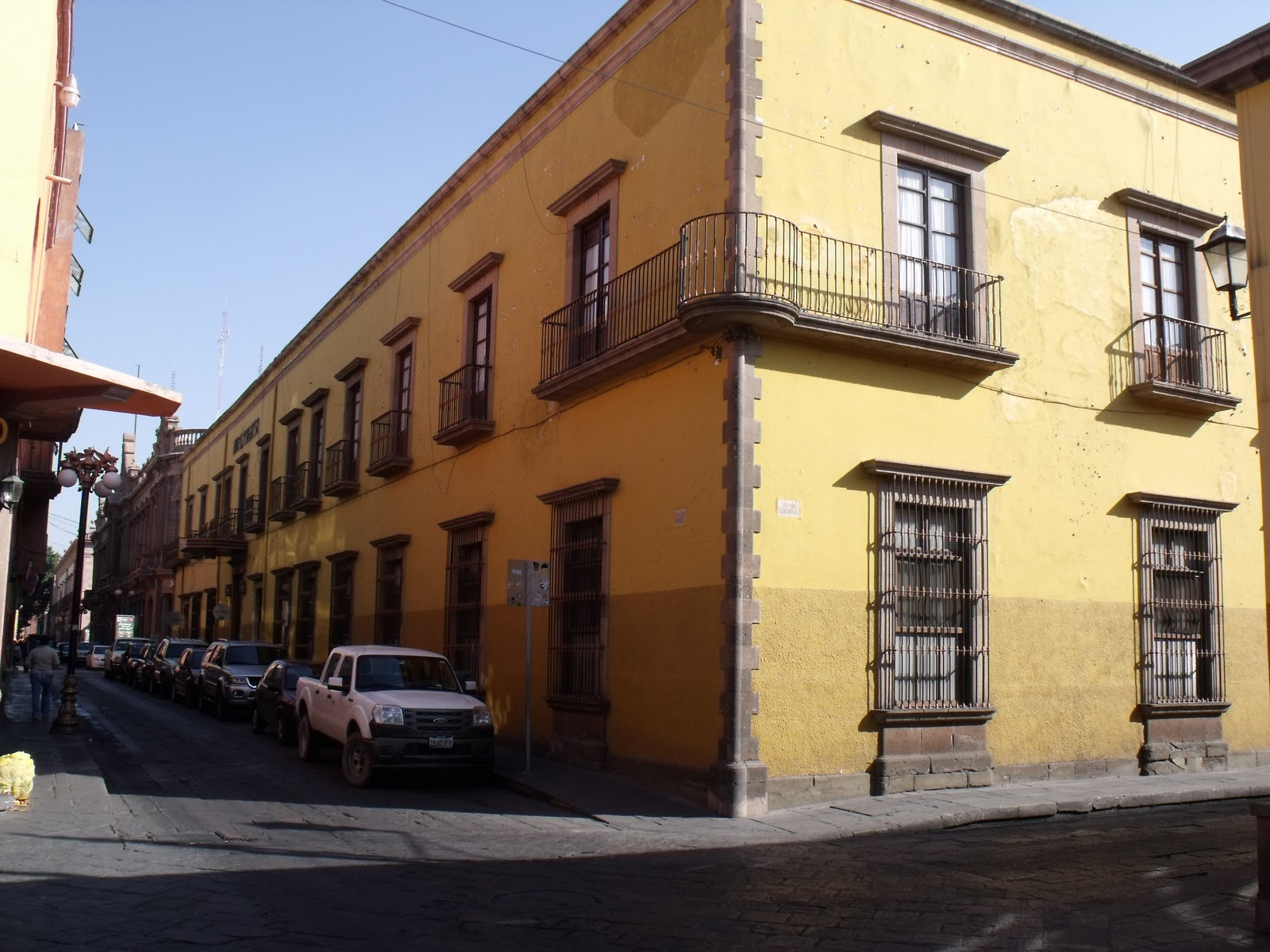
One of Pachuca's quieter streets.  Note mountain.

The entire affair is powered by two large weights and one smaller one, much as in a grandfather clock.  Every three days a crank is used to raise the weights to their full height.  Today was the third day and the guide did his cranking demonstration then got me involved.  At first the cranking was risibly easy but with time it got more and more difficult.  But this old dog of 67 was not going to show weakness to 6 young senoritas and mercifully the weight got to the top before I got to cardiac arrest.  The girls then had a go and I was amazed at how physically weak they were.  Maybe that was a good sign of easy modern living.

At the Pachuca mining museum
In the afternoon we visited the Museo de Mineria, which is a chronicle of the of the interesting mining history of Pachuca.  And interesting it is.  Silver was unearthed in this region as early as 1534.  Thereafter is a history of mining for gold, silver, and obsidian reaching into the 1990's (and possibly the present day, but I'm not sure.)  We're talking serious and extensive mining, at least on a par with Kalgoorlie in Western Australia. 

I had a special interst, of course.  My boat was built by a mining engineer in Western Australia.  I've been informed that a "pachuca" is some sort of vessel for treating gold ore in Western Australia.  Brenda and I suspect that that name came from a similar devise used here in Pachuca in its gold treatment process. 

Unfortunately although Brenda and I scrutinized the Spanish language exhibits very closely we could not find any explicit reference to any piece of equipment called a "pachuca", but then why would there be, if it was part of the local mining scene?  I did see a tantalizing reference to an invention by a local person of a new gold processing method, but could not find a definite link.


Brenda's Mealtime Story 4: A food specialty here is the paste. Pastes are very popular and there are many outlets. They are the local version of the Cornish pastie. Back around 1849, a British company bought into the mining industry here. They hired and imported some Cornish miners. These miners brought not only their skills in modern, more mechanized mining but the pastie which is ideal for the underground meal - pastry encasing a mix of beef mince and vegetables such as potato, carrot, turnip and onion. Pachuca pastes come with fillings such as well-spiced tuna and potatoes, chorizo and beans, and several more savoury fillings as well as a popular rice pudding, and a pineapple custard version. The pastry is either flakey pastry or rich flakey pastry. I have always liked pasties so it is a form of heaven to be in a city where they are so readily available.

Incidentally, the Cornish miners are also credited with introducing soccer to Mexico - now a national obsession.

Monday, March 14, 2011

Tula - Day 2

He is known as "Chac-Mool"
At 9.30 AM we took a cab for the short ride to the entrance of the Zona Arqueologica, the area of 16 km sq that contains the ancient ruins of the Toltec era (about 700-1100 AD).  After a chat with a very helpful information officer we visited the museum and got a glimpse into the Toltec civilization.  We then made our way to the center of what at its peak was a town of 35,000 people.  The site is a work in progress and much time and effort of unearthing and restoration will be required to realize the full potential of the site.

We were not disappointed with what we saw.  The site is atop a hill that dominates the immediate landscape and provides excellent views in all directions.  The dominant structures are two pyramids.  There are also ball courts (where the loser lost his life), a sacrificial altar, and a large building whose purpose has not been determined.  Atop one of the pyramids were columns that at the time supported a roof and were not visible to the population.

After our tour we left via the southern exit and made a short walk into the main town, using a colorful footbridge spanning the river that no doubt had provided the Toltecs with water. 
Panoramic of Ball Court
Main Pyramid

In the afternoon we made a short visit to the cathedral which was no match for the splendor that we had encountered in the churches of San Louis Potosi.
Pillars that supported roof on top of pyramid
Recurrent theme: serpent eating man
Bridge over river to main town

Sunday, March 13, 2011

Tula, Hidalgo

Today we made the journey from San Luis Potosi to Tula, in the state of Hidalgo.

We made the trip in two legs.  The first one was from San Luis Potosi to Queretaro, capital of the state of the same name.  We boarded the bus at 10 AM and arrived at Queretaro at 12.30 PM.  The fare for both of us was 340 pesos ($28.30).

At Queretaro we had to do the first serious waiting of our trip.  The bus for Tula left at 2.50 PM and arrived at 5 PM.  The cost of that leg was 260 pesos ($21.70).

During the trip we came perilously close to Mexico city - one sign said 95 km away - and we are not too far from the city of Pachuca, which is to the east of us.

The attraction of Tula is the nearby ruins of what was "the probable capital of the ancient Toltec civilisation ...."  Tula was an important city from about AD 900 to 1150, reaching a peak population of about 35,000.  The ruins are within walking distance from the town but cover an area of 16 km sq, so we expect to have a busy day tomorrow.

Another attraction is the large cathedral which is about a block away from our hotel, the "Casablanca".  The Casablanca is a pretty hotel set well back from the road.  The room is much more up market than what we've been used to in the last week, but it is nevertheless modestly priced at 350 pesos ($29) per night.  We have booked for two nights.

Saturday, March 12, 2011

San Luis Potosi - Day 3

Original, Signed by Benito Juarez
Our first visit of the day was to the Museo Reginal Potosino, housed in a building that was originally part of a Franciscan monestary founded in 1590.  The ground floor has exhibets on pre-Hispanic Mexico.  Upstairs is the lavish Capilla de Aranzazu, an elaborate private chapel constructed in the mid-18th century.  The entire upper section of the museum seemed to be dedicated to the Freemason history of the area.  I knew from previous reading the Freemasonry played a significant part in the development of Mexico.

Benito Juarez ran his government from this building during the French occupation.
Among Fredrico Silva Sculptures

In the afternoon we visited the Museo Federico Silva, housing the modern art of its namesake.  The museum is in a 17th century building that was originally a hospital then a school.
Breakfast

Brenda's  Mealtime Story 3: Breakfast this morning was again at the Cafe Torte. Today the cafe opened at 9.30 and we were the second customers. The proprietor remembered what we had yesterday and said "Today you will have...." He did check that I would actually like what he had decided for me - an omelet. Robert had no choice but he did like what came for him - one egg on toast with a mushroom sauce and one on a tortilla, with a ground and grilled meat topping. The omelet was cheese-filled with the same mushroom sauce. Both dishes included a serving of beans garnished with grated hard cheese. The cafe soon filled and some customers were turned away.
Saturday afternoon outside of Templo San Francisco

Friday, March 11, 2011

San Luis Potosi - Day 2

Hotel Lobby
The Hotel Progreso.  We're the 3rd window along.
We got an early start to the day with a telephone call from Australia telling us of the earthquake tragedy in Japan.  I connected to the internet and we looked at the latest news and many photographs.  I thought of the cruisiing yachts scattered around the Pacific ocean, many of them anchored or berthed in positions vulnerable to a tsunami.  Fortunately Pachuca was safe and sound on the west side of the Sea of Cortez with the Baja Peninsula acting as the biggest breakwater in the world.

We had a substantial breakfast at a nearby cafe, trying to get a good start to what we expected to be our one full day of touring in San Luis Potosi.  Brenda did some shopping among a group of nearby street vendors and she purchased some interesting necklaces and tiny purses.  She said that the Indians are very gentle people and allow one to look around without pressure.  I rate shopping just above a prostate examination and went to an ATM to draw some money out.

Indian Street Vendors
Brenda did some thinking while I was away and suggested that we spend 3 nights in SLP instead of 2.  We had originally planned on spending 3 nights, and given that we were happy with our lodgings and had so much more to see in this delightful city, I readily agreed.

Early Ornate Water Storage Tank
We spent the day walking around the center of the city visiting parks and old buildings and also finding surprises that had not been mentioned in the guide book.  One surprise was a very long tree-lined pedestrian open space where we saw one of the city's early water storage tanks, dating from the late 18th century.  A plaque describes it as "... being the most representative monument in San Luis Potosi City because of its elegance, which makes it appear more as an ornamental object than a place for water storage."  Next to this pedestrian area we discovered the Mercado Tangamanga, a fresh produce market similar to the Bravo Market in La Paz, except bigger.  We purchased some fruit and sweet rolls for lunch.
Long Pedestrian Way

Note Suspended Crystal Ship
Golden Altar with Scallop Shell Top
More Baroque Baroque
After lunch we took another stroll, following a path described in one of our tour guides, where we visited several more churches, including the Cathedral, which was built between 1660 and 1730 and is kept in remarkably good condition.  However, for us there were more interesting churches.  The Templo de San Francisco featured a crystal sail ship suspended from the ceiling.  Then there was the Templo del Carmen with its over the top baroque style.   A side chapel was in gold and topped with a giant golden scallop shell.  [Don't forget that you can see the detail in the photos better if you enlarge them by putting the cursor over them and hitting the left mouse button.]


Strong Mexican Music Tradition Lives On

Thursday, March 10, 2011

San Luis Potosi, SLP

Scenery on way to San Luis Potosi
Today we made the move from Guadalajara to San Luis Potosi and everything went amazingly well. largely because Brenda had done much research on buses and where to catch them. 

At 8 AM we positioned ourselves at the corner of Madero and 16 September, and within 30 seconds were on a bus to the central intercity bus station.  We walked into the ultra modern bus station at just before 9 AM and purchased two tickets with the ETN bus line at a cost of 820 pesos ($68.30) for San Luis Potosi, the capital of the state with the same name; and at 9.30 AM we were on the way to SLP.

The bus was far more luxurious than anything that Brenda and I had ever experienced before, with its wide plush seats, amazing amount of leg room with clever flip down supports that allowed one to lay back and rest with the legs up, movies (3 of them) or music with headphones, two toilets in the back, pillows, and snacks that we were handed as we climbed on board.

The countryside was rugged, volcanic in places, and much drier than we had expected.
Plaza de San Francisco, near hotel

We arrived in SLP at 2.30 PM fresh as daisies, walked to the road and immediately stepped on a bus bound for the central district of SLP.  We got off at Alameda near the old railway terminal as the guide suggested, then sat down on a park bench to get our bearings.  Then we started walking generally in the direction of the Hotel de Gante, the only "budget" hotel listed in the book, at a price of 390 pesos per night.  But I had learned the hard way that the actual price can be higher than the suggested price.  My theory is that the very listing of a hotel in a touring guide results in a price rise.  The plan was to keep an eye out for any other hotels that we might encounter on the way.

Fountain in same park
We turned down one street and up another in a quasi random fashion and at Aldama street spotted the Hotel Progreso, walked in, and saw that they were offering rooms at a special price of 270 pesos per night.  Brenda and I liked the room, I paid 540 pesos for 2 nights, and at 3.15 PM we had a temporary home in SLP.

The hotel is an old one - built in 1840.  The lobby is old world elegant and I'll probably post a photograph of it later.  There are two floors and we are on the ground floor.  The room is large (by our standards), with high ceilings, high windows and doors, and tiled floors.  In addition to the double bed there is a desk with chair, plenty of drawers, and a round table with two comfortable arm chairs.  As I said, we are at the street level.  The windows have bars on the outside (de rigueur in Mexico).  The wooden windows are fitted with curtained screens and solid shutters.  It's the sort of setup that would not be out of place in New Orleans.

After unpacking we went for a long walk around the district.  He hotel is superbly positioned in the old historic section of the city which as in Guadalajara has been nurtured and protected from car traffic.  We seem to be surrounded by plenty of old interesting buildings and beautiful parks and are looking forward to a full day of exploration tomorrow.

Wednesday, March 9, 2011

Guadalajara - Day 4

Templo Expiatorio
This morning we walked along Madero street and visited the Templo Expiatorio, a church that Brenda had seen both from the tour bus and the roof of the hotel building.  It turned out to be a gem that had been barely mentioned in our guide.  Elsewhere I found the following description: 'This "Expiatory Temple" is one of the most beautiful and imposing buildings in the city. Built beginning in 1897, it was not until 1931 that it was opened to the public. The imposing Italian neo-gothic façade is made of stone and, just as in the Middle Ages, no cement or iron was used in its construction.'

There must be something about Brenda and I as tourists because once again out of nowhere appeared a man who gave us a description on the building and explained that the sculpture in front of the church depicted Pope John XXIII anointing Mexico's first cardinal.
On our way back to the hotel were attracted by a pretty park and from there noticed yet another church, Santuario de Nuestra Senora del Carmen, which had an emphasis on women.  It was a very pretty church and as usual we took some photos.

Carmen Park
Santuario de Nuestra Senora del Carmen
In the afternoon we visited the regional museum of Guadalajara where we saw good examples of the paleontological and human history of the area.  In the upper floor we saw scores of religious paintings principally from the early 18th century.

We decided to leave the following morning as planned and take a bus to San Luis Potosi.

Blog Archive

Contributors

Statistics Click Me