This blog began in late 2006 with the planning and preparation for a circumnavigation of the world in my 39-foot sail boat Pachuca. It then covered a successful 5-year circumnavigation that ended in April 2013. The blog now covers life with Pachuca back home in Australia.

Pachuca

Pachuca
Pachuca in Port Angeles, WA USA

Thursday, January 17, 2013

Mainsail at Loft, Fiberglass Work

I was up at dawn yesterday to find the wind very light and after breakfast I serviced the 1st of the two remaining winches.  At 9 AM I telephoned Steve at North Sails and suggested that I raise the mainsail for him to come and see. He agreed and by the time he arrived at 10.15 AM the mainsail was fully up. I had the usual difficulty of raising the sail from the cockpit using the winch so I jumped the halyard at the mast and I got the sail 4/5 of the way to the top with amazing ease. Even though I purchased a top of the line turning block for the base of the mast, I reckon that that 90 degree turn is what has been causing my problems. I am going to experiment with jumping the mainsail halyard at the mast as far as I can, cleating it off, taking up the slack to the winch, then going back to the mast and undoing the cleat. If this works I may put a winch at the mast and do the raising from there.
Vent to be removed and deck sealed

Mainsail up, with Stack Pack hanging down

Nice clean layout with no lazy jacks or stack pack
Note two existing sets of reefing points

Steve and I had a very good session. He liked the sail, stating that it was of good heavy material and well reinforced at the various stress points. He could tell by looking that the sail needed a third reef and he described just where he would put the new reef line, about 2 meters above the 2nd reef along a line of stitching mid way between two battens. He asked me to send data on my storm trysail to give him an indication of how much area of sail the 3rd reef would yield. 

This morning I sent him the following data on the trysail:   luff: 4.61m (15' 2"), leech 5.81m (19' 1"), foot 2.91m (9' 6.5"), yielding an area of 6.7 sq meters (72 sq ft).  This compares with the 144 sq ft that I calculated for the mainsail at the 2nd reef.  The third reef should give me an area between the two.  I also told him that the mainsail and stack pack dated from 2005.

He had a look at the clearance between the boom and the spray dodger when the full mainsail is up and found it to be a satisfactory 9".  This will allow him to raise the back of the spray dodger 2 or 3 inches, allowing drainage of water forward along the top and making my access to the companionway a bit easier.  Before he left I asked him if he had all the information that he needed to proceed with the new spray dodger and the canvas to be fitted to the sides of the cockpit frame and he replied that he had everything that he needed.  I reminded him that I would need the side tracks for the spray dodger so that I could fix them into position ahead of time.

He expected to visit the club this morning at around 10 AM and could have two of his men pick up the mainsail, so I undertook to have the sail on the deck ready for the pickup.  I started off by removing both lazy jacks and as I did that I realized what a great job I had done in setting them up in Argentina.  They were strong, well fitting, and would have lasted for years.  Nevertheless it felt great to bring them down, although I packed them away carefully just in case I find later that I need them again.  I then removed the stack pack (sail cover) and folded it way, although most likely I will put it in the garbage where it belongs.  I say that in spite of the great work that Pato Salas had done in Argentina to repair and improve the stack pack.  After his work it was a joy to zip and unzip it and the plastic tubes on the side were now straight and matched the blue color of the canvas material.  Nevertheless there is only so much a patch up can do to to improve a fundamentally flawed design.  I then freed the mainsail and spent over an hour flaking it across the boom as best I could then lashing it in a bundle with about 7 straps and laying it on the side deck.  I forgot to mention that Steve had told me that the battens would not have to be removed, which saved me a lot of time and effort in removing them and later re inserting them.  It meant, though, that the bundle was quite long.

This morning about about 10.15 two men came and carried the sail on their shoulders with no problem.  While they were here one of them asked me what work was to be done on the sail.  After I told him he asked me when I would be departing Cape Town.  When I told him early March he replied No Problem because they'd have the sail back in about a week. 

I then attacked the starboard quarter berth in earnest and gave it the best cleaning since leaving La Paz.  While I had the opportunity I sprayed liberal quantities of WD 40 on the joint there the autopilot linear drives meets the steering quadrant.  I then repacked the area and must have made a few improvements because at the end there seemed to be more free space and light coming in from the side window.  When that was finished I cleaned the area between the quarter berth, taking the trouble to lift the floor in order to inspect and clean the area around the propeller shaft and dripless packing.  Then I figured that as long as the area was clear I may as well drain some fuel from the bottom of the diesel tanks.  The port tank required a piece of wire to get things flowing but thereafter it flowed well and I got neither water nor those black gooey globs associated with algal growth.  The port tank was just as good, with no evidence of water.  I was pleased and relieved at this, given the extremely rough seas that we had encountered on the passage from Brazil.  I worry about water entering the tanks through the air vents.

It is interesting how random events can lead to a productive result.  A few days earlier I had taken a photograph of the fiberglass work being done on Vinny's boat to seal the holes left in the hull after the marine head had been removed.  I remembered marveling at the ease with which these fiberbglass men could fill in a hole capable of withstanding the stresses of an ocean passage.  This morning I tripped twice on that useless vent on the side deck.  It was a vent retrofitted by some ham fisted person from the look of the hole that he cut through the side deck, so that an exhaust fan could suck up cooking fumes from the stove.  When I purchased the boat I found two bare wires, so my guess was that sea water had come down the vent and ruined the fan.  For me it was a leak-prone tripping hazard.  Pretty well on the spur of the moment I went to Action Yachting and asked it they could arrange to have the vent hole fiberglassed over.  Within 20 minutes David, the manager who had been so helpful with my communications dongle, was at the boat and we discussed the job.  Their patch will have a smoother surface than the non-skid texture of the boat's but will flush with the deck and plenty strong enough.  David will schedule the job for next week.  It will be great to never have a leak from there again and never again trip on the vent scoop.

In the afternoon I set off to find the bus that would take me into the city.   The bus station was actually quite close to the marina.  I walked to the end of the marina then  up some steps to pedestrian foot bridge that took me above the may rail tracks and the highway.  However, halfway along the footpath is a set of stairs that leads to the bus station.  It may be a bus, but in all other aspects it is more like a train, complete with dedicated roadway, platform, and side access like a subway.  At the station I purchased an electronic card and loaded it up with enough for 10 trips.  The end of the line is the Civic Center, which was only a short walk from the heart of the city.

I wandered around the city until I found  a unisex salon and got a terrific haircut from Dulcie.  We chatted away about my sailing adventures and when I told her that I was going to shave off my beard she offered to cut the bulk of it off with her electric cutters, leaving me with just a stubble to shave off.  The hair, eyebrows, beard, and mustache trim came out to only 100 rand.  I then went on to the Food Lover's Market and got another 3 days' supply of food.  I then took the bus Thibault Square in the middle of the city to the Civic Center where I caught the bus back to Woodstock Station, my stop.

When I got off the train I saw the clouds cascading down the face of Table Mountain like an avalanche and knew that we were in for a big blow at the marina.  The clouds are known as "The Tablecloth" and are a sure indication of strong winds at the marina.  Sure enough walking along the footbridge was a challenge and the marina jetties were a particular hazard, certainly a danger for light adults or children.  I turned on the wind instrument and saw a gust of over 45 kts but I wouldn't be surprised if some were reaching 50 kts.

 I then went for a shower then had my first shave since Brazil.  While I was toweling off an older gentleman came in wearing diving gear.  After a couple of minutes he said "Did you go around the Horn?"  "Wow, news gets around fast." I said.  He replied that he had noticed the ring on my ear, which I had totally forgotten about.  I explained how I had indeed rounded the Horn west-to-east with the cape to my left, which entitled me to wear the ring on my left ear.  As I left I thanked him for noticing the earring and its meaning.  He was the first that I know of, and I hope that there will be others.

Afterwards of course was the obligatory half liter glass of cold draft beer.


Tuesday, January 15, 2013

Winches Serviced

Today was a sunny but windy day so I decided to stay on the boat and begins servicing the winches.  By 7 PM I had serviced the 4 cockpit winches, Maxwell two-speed self tailing 28's.  Four winches in one day was a new record for me, but servicing regularly seems to pay big dividends in the ease with which the winches can be taken apart and cleaned.
First winch ready for cleaning and lubrication.  Note sheet to guard against parts and tools going overboard.

I found that the lanolin grease that I had used in my last service in Argentina had worked very well.  The old grease was much easier to remove than the standard winch grease.

At the end of the day the four winches were moving and clicking like new ones so I rewarded myself with a long hot shower and a tall draft beer followed by 2 glasses of house red at the bar.

Early tomorrow I will tackle the 2 Maxwell 22's on the cabin.  Because they are smaller they are easier to service so I think that I can do them in the time that it takes to service one of the 28's.  If the wind is light as expected I will then raise the mainsail and call Steve to come and have a look.

After the winches are serviced the only major hands on maintenance task will be an oil and filter change of the engine,

Monday, January 14, 2013

Contact with North Sails

I telephoned Steve Meek at North Sails this morning and we had discussions that exceeded all of my expectations.

From the moment we began speaking on the telephone I felt that we were talking the same language and had the same ideas about the issues.

After introducing myself and explaining my situation I asked him if he could make a new canvas spray dodger for me, and he replied No Problem.  I told him that he could use the existing dodger as a template but there was one modification that I wanted to discuss with him.

The next question was could he restitch my mainsail because it had done a lot of miles and I was worried about UV damage to the stitching.  He agreed that it was a good idea and he would put two additional rows of stitching on the sail.

I then told him that I wanted to discuss with him the possibility of a new mainsail cover and when I described my setup with a stack pack and lazy jacks he passed some interesting opinions on stack packs.  He thinks that they are necessary on certain boats, for example on big catamarans where the boom is too high for easy reach, but he would not recommend one for a cruising boat like mine because it results in thousands of miles of sailing with the stack pack hanging or tucked into the sides of the boom,  As for lazy jacks, he had doubts about them being worthwhile.  That launched me into a monologue of everything that I hate about my lazy jacks, and he could understand my problems.  He thinks that lazy jacks are useful for the initial drop of the sail, but it should be a simple matter to jump on the cabin and tie the sail to the boom.  I liked what I was hearing and I thanked him for letting me know that I wasn't some sort of extremist on the issue.

Steve arrived at the boat just after noon and we spent an extremely productive 2 hours discussing the work.  When he learned that I had only two sets of reefing points he expressed some reservation which got me started on my regular complaint that the second reef leaves me with too much canvas for sailing or even heaving to in heavy weather.  He told me that he could add a third reef to the sail.  We looked at a method of adding a third reefing line and I concluded that it would be too complicated, what with a cheek block on the boom, 2 more blocks at the mast, another line into the cockpit where there was no room in the organizer or the cleats.  I jumped at Steve's suggestion that I simply move the 1st reef line to the 3rd reef point when I go to the 2nd reef and expect worsening weather.  I will master that technique because I will be determined to make it work. 

He then took measurements for the sail cover and described how it would be constructed and fit.  I had suggested that the front of the cover should be tied at the front of the mast in order to let air pass through to dry the sail but he advised to have a zipper to prevent dust and grime from being brought in by the wind.  This made sense to me, so zipper it will be.  I complained that the mast steps never line up with the openings provided for them on the stack pack and he told me that his measurements were for the sail cover to go over the mast steps, with a strip of reenforcing inside of the cover.  That sounded good to me.  I then asked him if we would have to put slides along the foot of the sail and here I learned something new.  I had thought that the mainsail was loose footed as a necessity in order to allow the stack pack to slide on, but in fact a loose footed mainsail is preferred because it yields a better sail shape.

So it was settled: an ordinary sail cover, no lazy jacks, and I would be able to sail with a clean boom where I could see the entire sail and not have canvas hanging off the sides.  No longer would I have to deal with lazy jacks that got hung up at the ends of the battens when raising the mainsail.  It was exactly the setup that I wanted to return to.

We then had a look at the spray dodger.  With no comment or prompting from me the first thing he said was that he didn't like those press studs used to fix the canvas to the coaming.   Bingo!  Bulls Eye!  That was exactly the modification that I wanted to discuss.  He said that a track and a bolt rope as there was along the front of the dodger was the way that he would do it, which was the solution that I would have suggested.  So we'll have the dodger firmly fixed along the sides with strong and well sealed tracks.  He suggested raising the back end of the dodger a few inches, and I agreed, pending an examination that I describe below.  Steve agreed that 2 windows was preferable to one big one, and although they don't use window covers much in Cape Town he agreed to provide them after I explained the strong summer sun in Western Australia.

I also asked him if I could try out an idea with him that me might think a bit loopy. He replied that he does all sort of special things for people.  I told him how when hove to the boat will not point sufficiently into the weather because there is not enough windage aft of the mast.  My idea was to fix heavy canvas material on the upper half of the side of the cockpit frame.  This would provide an area of resistance of roughly 0.5 by 2 meters, or 1 sq meter.  That may not sound like much, but in a gale it could provide a significant turning moment mostly behind the wheel.

Steve though that it would work so we discussed its design.  He came up with the idea of extending it to the davits for that extra bit of area, which made sense.  The material will be strong, relatively cheap, not very UV resistant, though I don't think that it will be an issue since I would expect to use the material only in heavy weather.  The canvas will be fixed to the frame at the 4 corners and along the horizontal bar at the bottom.  Steve did not think that the zipper for fixing the sun shades would be strong enough for the job so the entire upper edge will be unsupported.

Then there was the question of one canvas which could be fixed to the appropriate side for heaving to, or two canvases.  I was leaning toward two in order to have them both set up and feel free to heave to on either side.  Steve then thought that using one canvas on each side will create a "slot" affect (i.e. the wind speeding up between the two canvases as per Bernoulli's Theorem) which would add to the turning moment on the stern.  So two canvases it will be.

If this canvas idea works it will transform my heave to experience.  I might even be able to heave to with the storm trysail or the 3rd reef of the mainsail.  

Steve then returned to North Sails - which is only about 2 km away - to work out his quotations.  My task is to fully raise the mainsail on the first quiet day (the wind is howling today) and call Steve so that he can plan the location of the third reef and, most importantly, measure the clearance between the boom and the spray dodger to determine if raising it a few inches is feasible. 

I asked Steve if he had enough time to do the work given that I was departing for Australia on 4 March.  He replied that there is plenty of time.  He said that they do sail repairs in 3 or 4 days, maybe a day or 2 later if there is a regatta on.  He saw no problem in getting the work done on time.

We also had a discussion about Vinny.  It turns out that Vinny has been around the Cape area for over a year.  Somehow he managed to beach his boat near Simons Town and it had to be dragged off.  Even back then he was on crutches.  I had assumed that Vinny had broken his leg during the collision with the container but no, it's an old break.  Vinny had told me that it would take time to heal, but gee, a year sounds like sufficient time to me  He had had his 50' boat at the corner only a few feet from Pachuca's present location and apparently the dog drove people nuts by barking at everyone who came by.  The yacht club just doesn't want him around and yet there he still was.  Steve pointed to where his bow was sticking out a few feet from behind another boat.  He had sneaked to the end of the jetty overnight which explains why I had not seen him at the VandA marina. 

Steve knew Vinny's present boat quite well.  He went out on her first sail in the late 70's.  They had a spinnaker up, broached, and when the boat came back up the mast was on the side broken.  Steve thinks that the boat is not very suitable for cruising and could definitely do with a second set of spreaders.  I said that I doubted that Vinny would go to the trouble and expense.  I was too busy today to visit Vinny but if he is still there in the morning I'll pay him a call.

Steve and I talked a bit about Jon Sanders whom he had met twice over the past couple of decades.  I told him that my experiences had greatly increased my respect for Jon as an outstanding sailor.  To do a triple non stop circumnavigation both ways means that you can't pick the optimal season or the optimal direction (e.g. rounding the Horn East to West) which means that you take the worst that nature can throw at you. 

Steve himself is an accomplished sailor, with from memory 3 Cape Town - Rio races and many other international ocean races under his belt.  He told me that he had a place on one of the Whitbread races but decided to return to SA for personal reasons.


Sunday, January 13, 2013

Toilet Fixed

Sunday Morning Walk to the Market
At this point the entire boat has been cleaned with bleach except the starboard quarter berth area which I will be doing in the coming week.  The head and all of its storage above and below the wash basin is clean, as is the interior of the closet, all of the cabin and galley storage, and the navigation station. 

Yesterday I tackled the port quarter berth area in spite of the fact that the cabin was crammed with the material from the V berth area and found that conditions were not as bad as I had expected.  The cover over the mattress was damp but the mattress itself was so dry that I elected to simply leave it out in the sun for the day.  I wiped every surface in that section and found little if any mold.  I washed the cover and hung it out to dry.  In the late afternoon I restored the area so that was more task off my list.

Unfortunately one of the V berth mattresses proved to have moisture in it even after 2 days out in the sun so I slept on the cabin settee one more night and today put the mattresses on deck for another day under the very hot sun.  For the third day the sail lockers were getting a good airing which was a very good thing.

I made a mistake in setting up the boat's electric cable yesterday afternoon rather than walking to the Food Lovers' Market.  When I reached the market at 5 PM it was closed.  This morning I walked back and it was still closed.  Never mind, because it was another beautiful sunny day and the walk around town would do me good.

I walked on the the V&A Waterfront hoping that the market that had been closed during my first visit would be open this Sunday morning, and so it was. I purchased a yummy looking roast beef roll for lunch and a loaf of pure rye bread.  I resisted the ice cream, pastry, chocolates, cheeses, etc and didn't purchase fruit because I still had a punnet of grapes, one mango, and one nectarine in the refrigerator.  For tonight I would have  a tall beer at the club overlooking the boats followed by dinner. I had seen their menu and it was good without trying to overreach.  Their prices are good and I noticed that wine is fairly cheap in SA.

Before leaving V&A I visited the marina and had a very good look for Vinny's boat, from above the marina and from walking two of the jetties.  He was not there so possibly he was allowed to stay at RCYC one more night.

After lunch and a short nap I decided to dedicate the rest of the afternoon to investigating the problem with the Jabsco marine head.  Fortunately it was clean both inside and out because it had not been used for months other than the occasional flushing to remove the stagnant sea water.  I had a choice between starting at the inlet thru hull fitting to ensure that there was no blockage and opening up the pumping mechanism, and fortunately I chose the latter.  The joker valve was in good order so I removed the top 6 screws and lifted the top cover and plunger.  I immediately saw that a hard piece of plastic was lying askew on top of the rubber piece that contained the two small valves.  The rubber and the valves looked good, but I couldn't figure out where to put the plastic piece.  It didn't make any sense because one of the valves had nothing to seal against.  I then removed the entire rubber piece and immediately saw the proper position of the plastic, and now the valve would be able to seal against it.

I could not see any way in which this could have happened during normal operation of the pump and concluded that I must have assembled it incorrectly many months earlier when I had put a service kit through it.  That would explain the feeble action on the upstrokes and my lack of confidence in the unit.  If that's the way it happened then I must have had a really, really bad day when I put the kit through it.

Anyway, the head seems to be performing normally, the rubber components all appear to be in good order, and the thru-hull fittings were cleared in Bracui; so there is hope that I will be able to use the head all of the way to Australia.

While working on the marine head I tried the radio one more time and finally found a rock station to my liking.  Life in Cape Town just kept getting better.


Although it was only 4.30 PM and the sun was still high I decided to call it a day because I had achieved my goal for the afternoon.  There would be a hot shower then a tall glass of beer overlooking the marina followed by dinner.  This was so much better than being pounded for hours in a gale.

Saturday, January 12, 2013

Vinny

I met Vinny outside of the boat shop when I was trying to solve my communications problem.  He was sitting on the ground with a crutch on either side and his scruffy terrier beside him.

Vinny is French, was an architect/engineer in a former life until he started sailing in the year 2000.
To date he has crossed the Atlantic 7 times and has found is way to Cape Town in extraordinary circumstances.

His boat struck something off the Namibia coast - he thinks probably a container - and he was forced to take to his life raft with a broken leg.  He was rescued though he was forced to abandon his 50 ft aluminum boat.  I told him that abandoning your boat must be the most painful experience that a seaman can endure.  He shrugged his shoulders and indicated that he simply had to move on.  He had earlier mentioned the great Montessier and I pointed out that he had lost his boat at Cabo San Lucas Mexico and went on to further adventures.

Vinny had purchased a 10 meter boat here at RCYC.  He told me that in 2 weeks he had stripped out all essentials: The electrics, galley sink, Jabsco marine toilet, navigation table, and many other things were eliminated.  And he wasn't kidding.  The boat was on the hard stand where workmen were fiberglassing the 3 thru-hull holes of the head and galley sink and Vinnie invited me to have a look.
Vinny's 10 Meter Boat

Sailing companion

Two Toilet Outlets Filled In

Vinny in His Cabin.  Note Candle.  No Boat Electric Lights.

 Inside the boat looked a shambles.  The fiberglass man asked me if I was the previous owner and I replied No, because if I were I'd be crying like a baby.  He laughed and told me that it had been a nice boat 2 weeks earlier.

But latter I saw Vinny on board and he explained the logic of all of his harsh changes snf it all started to make sense through his eyes.  Once I threw overboard ideas of aesthetics and comfort and focused solely on functionality, every change that he had made was sensible and commendable.  Thus he got rid of the nav station in order to store things and he would use the saloon table for his navigation work.  He cut a big hole to access the engine so that he could start it with a screw driver to the solenoid because he had removed all of the electrics.  He removed the galley sink so that he could site the batteries near the engine.  He removed the big sliding doors at the galley because they would be a pain to move back and forth and now has easier access to the setup that he wants.  He removed the Jabsco toilet because he preferred the reliability of a bucket (which is what I had to use on the passage from Brazil).  Etc etc etc.

I told him that the tiller looked a bit short and he agreed, and plans to lengthen it.  I then said that he anchor looked a bit light and he pointed to a heavier one in the area that had been the navigation station.  I then asked him about the sails, their condition and whether there were spares.  This was a weak area and I hope that he does something about it.

Unfortunately he was forced to leave the marina, partly because of the concern over his healing broken leg over the uneven wooden jetties, largely because his dog is not allowed, and technically because having purchased the boat at RCYC he cannot live aboard unless he is a member.  He was given until noon today to clear out and was headed for the V&A marina.  Arnold and I thought it was a good idea that I offer to help him move the boat to V&A but when I asked him about it he told me that there was no need because he already had a friend lined up to help him

Vinny expects to be at VandA for about 2 months so I hope to see him again and see if he still wants my surplus water and diesel containers.  From SA he will push on into the Indian Ocean.  I asked him whether he would visit Australia but he said No because the dog would be a problem with both Australia and NZ.  (Australia would require a 6 month quarantine of the dog, according to my last information on the matter.)  He would visit Indonesia, Thailand, etc. 

I think that the best way to describe Vinny's tragedy is to quote an email that he sent to me.  Unfortunately he left before I could get his permission to publish is email but I don't think that he is the kind of man to worry about that.

The interesting thing is that I remember receiving a Securite from SAMMNet warning of containers of Namibia.

Note the magnificent behavior of the captain of the rescue ship.

"Hi my Friends
Tragic destiny, Yumapi sunk on 22 December at 8.am, bumping against probably a container in half immersion, in 2 hours. Pos 27.19 S 7.34 E 400.nm offshore Namibia coast. By my sattelite beacon, I was safe the day after at 2.am, a very long time to wait in the life raft. The crude oil carrier Maria from Euronav Cpy 270.m save my life in terrible and difficult condition, at first try to wait the life raft drift along the carrier,  but finally make course on me at 1.5 kn. Imagine the bow of the tanker coming on my life raft, the coming alongside was like Indiana Jones movie. But the most difficult was to come on board after hitch the life raft.
A wall high 6 to 10 m because the swell and I have to seize a ladder at the good moment with my broken leg, impossible.
Finally they drop down a boarding step,  but that was very dangerous because the swell, risk to be crush by the heavy boarding step, sometimes in water and sometimes in around 2 m over me.
But I was lucky and the guy on the boarding steps seize me at the good moment. The Maria Crew and Captain was wonderful with me, gave me cabin, clothes... The crew was mainly from Greece and Central America. Maria destination was Houston, but finally changed course to let me in Bay of Cape Town on 25 December. Maria engine consumption is around 70.t per day, Maria weight is 23 000.t, so you imagine the cost of the decision to let me in Cape Town, and they payed the Hotel Southern Sun in Downtown. In bay of Cape Town, the sea rescue launch grabbed me and let me in Waterfront. Problem with the custom, I was considered like a boat people rescue and Maria Captain had to book a flight for Paris on 26 December to got the authorization to let me in Bay of Cape Town !!!!! Finally I got a visa for 3 months and canceled the flight. Today I am still on hotel Southern Sun, because my left knee is really bad, difficult to forget Yumapi, Yumapi is every where, at first I decided to change my e mail....., most important is to recover a good leg, anyway hard 2012, hard days...... Hope see you
All is to build again, build a new home, a little one, to still to be a sea vagabond's world

Vinny"


Photos of 1st Stroll Through Cape Town

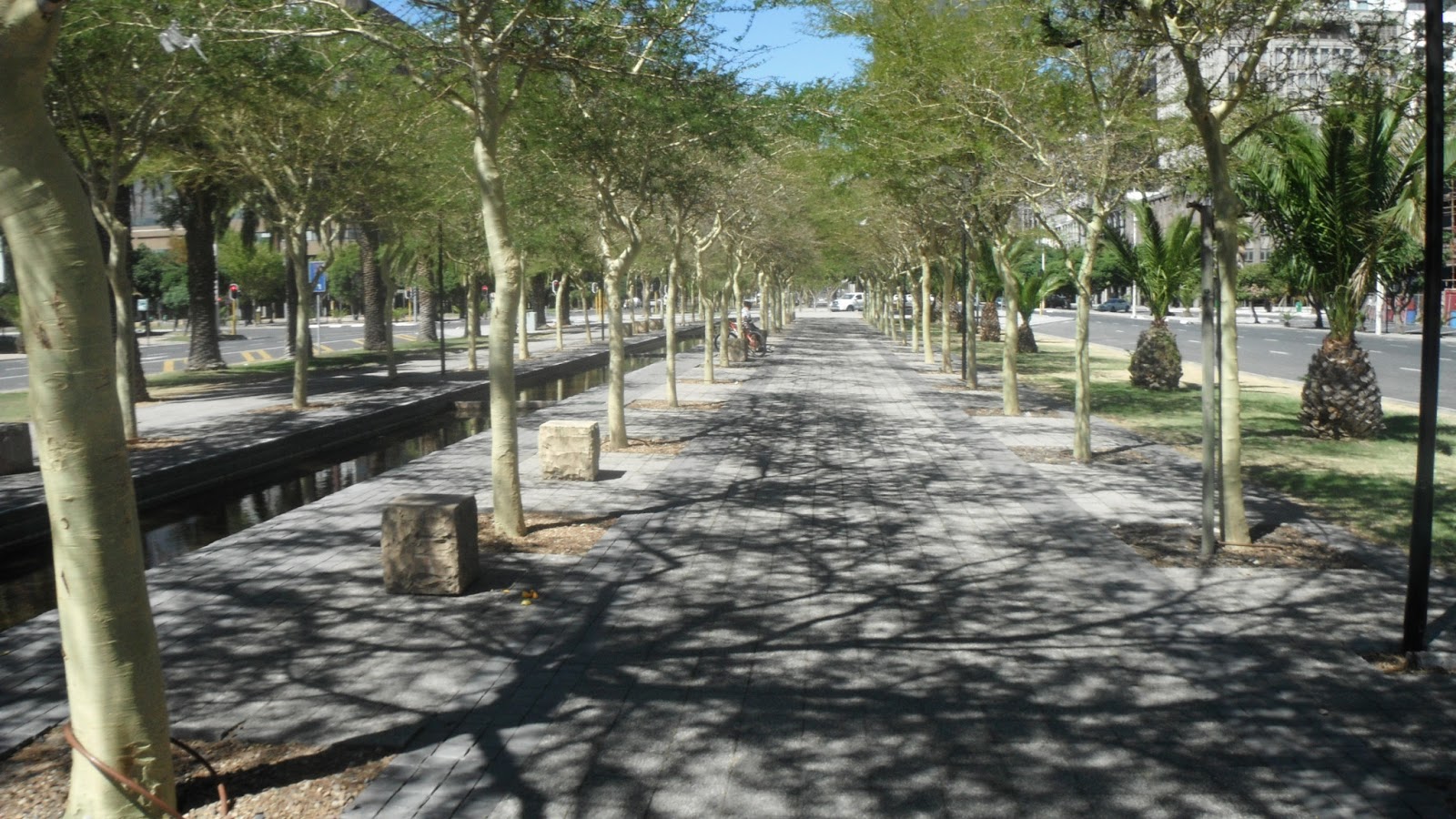
Here are some photos that I took on my first walk into the city, last Monday in order to clear Customs and Immigration and still feeling pretty woozy.  They are mainly of the picturesque VandA ("Victoria and Albert") waterfront.  There are two foot bridges that must be swung open to give boats access to the VandA marina.

Gracious Living at VandA Canal

Retired MCycle at Police Office


South Africa boasts 10 Nobel Laureates: 4 for Peace, 3 for Medicine, 2 for Literature, and 1 for Chemistry.  The Nobel Peace prize winners were: Albert Luthuli 1960 (President of ANC), Desmond Tutu 1984, F.W de Klerk and Nelson Mandela 1993.  There is a photo commemorating the four great people.  (See http://gobackpacking.com/photo-favorite-south-africa-4-nobel-prize-winners/)

Looks Like Ship Facility from Early 20th Century

This footbridge draws up

The VandA Marina

Access to Sea at Left


L-R: Lothuli, Tutu, de Klerk, Mandela

VandA Marina

There are several photos of the genteel living along the canals that are part of the VandA waterfront.


Communications and Power

I walked over to Action Yachting chandlery just off the end of my jetty yesterday and asked if they sold telephone cards.  I was told that they used to but did not sell them any more.  I asked the young chap where I could buy them and he went to the back office to ask.  The manager of came out and told me where I could purchase them on Adderley Street.  When he learned that I would be walking he told me that he would get his driver to get them for me in the afternoon.  I told him that I didn't mind walking but he insisted and I thanked him very much.  Twenty minutes later I was back in the chandlery with ZAR600 in cash and a note requesting ZAR500 in international cards and ZAR100 in domestic cards.

The manager came out and when he saw the amount of money I wanted to put into the phone cards he got an unhappy look and said that there must be a cheaper way.  Soon we were talking with a man who had used a dongle which he plugged into his laptop via a USB port and which would connect into the internet via the mobile telephone network.  This was precisely the system that had worked so well for me in La Paz.  I agreed with the proposition and the manager told me to return to the shop just before closing time at 5.30 PM.  I asked him if he needed more money and he smiled and said No.

At 5.30 PM the dongle was waiting for me.  It had cost ZAR400 and they purchased ZAR200 worth of service.  Proof of identity was required for the purchase but fortunately they accepted the information on my identity provided by the driver.  The dongle came with the sim card already installed and has 3GB of storage capacity on board.  I plugged in the dongle, the appropriate driver was installed by the Win7 OS, then the software installation wizard came up and in no time I was connected to the internet.  I have made Skype calls from the comfort of my boat to the USA and Australia with outstanding performance.  As far as I am concerned my communications problems are over.

This afternoon before leaving for a walk into town for some food shopping I decided on the spur of the moment to try to connect the boat to shore power.  Fortunately I had cleared out the port quarter berth in order to dry and clean the area and found the cable stowed underneath.  The plug that I had purchased at Action Yachting a few days earlier was smaller than the one I had used in Brazil, but was of the exact same design, so swapping over required minimal effort, given that the wires were already cut and bared to the correct length.

After cleaning the male plug blades on the cockpit bulkhead with sandpaper I plugged in the cable then went to the dock and plugged into shore power.  There was no electrical explosion so I went into the boat and plugged my workshop lamp into one of the 240V wall plugs and the light came on.  Then came the big test.  In Brazil the 220V system had not been enough to drive the 60 amp Mastervolt charger hard wired into the boat and I had been forced to use what weak power I could get from shore using extension cords, and of course the batteries were not being charged.  I was hoping that SA's true 230V system (as opposed to Brazil's 2-phase 110V) would provide enough grunt to activate the Mastervolt.  I switched on the Mastervolt and it came alive and I noted from my DC meter that it was delivering 28 amps of power into the boat's batteries. 

So now I have unlimited electrical power from either the boat's 240V wall outlets or the boat's 12V battery bank.  The refrigerator will now stay on all of the time, and I'll now power the computers via the 240V outlets rather than 12V inverters.  My electrical problems are over.

2 out of 2 big wins in one day was very satisfying, and with that I went for my walk into the city

Blog Archive

Contributors

Statistics Click Me