This blog began in late 2006 with the planning and preparation for a circumnavigation of the world in my 39-foot sail boat Pachuca. It then covered a successful 5-year circumnavigation that ended in April 2013. The blog now covers life with Pachuca back home in Australia.

Pachuca

Pachuca
Pachuca in Port Angeles, WA USA

Monday, June 15, 2015

Grounding

Last weekend I ran aground hard on the Parmelia Bank, east of Carnac Island.

I had arrange to have a sail with Paul on Sunday because the forecast was for clear weather and a moderate SE wind.  I was up at 4 am, picked him up at his place in Chidlow at 6 AM, and we were in Fremantle at 7 AM.  The boat was ready to go because a few days earlier I had reassembled the LPG system and the day before topped up the tanks with 45 liters of diesel.  We set off for South Passage, between Garden Island to the south and Carnac island to the north in order to get out of Cockburn Sound and sail along the west side of Garden Island.

As we passed along the east of Carnac Island over the Parmelia Bank I kept an eye on our position and SE track mindful of the rocks to the south of the island.  We were making about 5 kts under full mainsail and half of the jib rolled out, with a 12 kt breeze off our port beam.

The shallow water alarm went off and before I could react we were bumping along the bottom under sail.  By the time we dropped the sails we were well into the shallows with the boat regularly rising up then bumping back on to the bottom in the gentle swell.  Fortunately the Parmelia Bank is of sand and weed, so I was not too concerned about structural damage to the hull, but nevertheless it was very unpleasant to experience that incessant thumping of my boat onto the bottom,

I had two problems with the situation.  First, I could not tell the best direction to take for the deeper water.  Even if I did know the best direction, the boat did not respond well to the propeller, whether forward or aft.  I churned up a lot of sand but got little movement and worse, had no control of the direction of movement.

Had we been isolated I would have checked the tide and confirmed my suspicion that it was falling and would not reach its next high for almost 24 hours, launched the inflatable, surveyed the area for the closest deep water, rowed out and dropped the anchor then kedged our way out by winching the boat along the anchor chain using the engine to help us along, with the boom out to the lee side to try to get the boat to heel over and reduce its draft.  But we were in Cockburn Sound.

 I got on the VHF radio and hailed VN6DI on channel 73.  In 20 minutes a boat from Cockbun Sea Reacue was at our side.  They surveyed the best way out (pretty much the way we had come in), tossed a heavy harness which we passed on each side of the head stay and made fast to my strongest cleat,  and dragged us for several minutes through the bank into deeper water.

While waiting for the rescue boat I had been wondering how I could have been so careless in my navigation.  After the crisis was over I would have to carefully analyze what had gone wrong.  Then one of the men in the rescue boat mentioned that the water in this area was shallower than indicated in the chart.  That was very interesting.

The incident knocked the stuffing out of me regarding sailing, and in any event I judged it too risky to venture out into the open sea west of Garden Island without being completely sure that the boat had not been damaged.  But as we approached Fremantle I started feeling better and we spent another 3 hours doing a very pleasant sail to the north along the coast then back south into the marina.

Back at the club ran into one of the two men that had been sent out by the club in a RIB to assist us and he told me that in winter the Parmelia Bank increases in height and it can get as shallow as 1 meter.  My reaction was along the lines of  'What???  Isn't the chart supposed to show the guaranteed minimum at the LAT (Lowest Astronomical Tide)?  Nobody has ever told me about this!"  The man told me that they used to actually surf over that bank in one of the club's wood hull boats.  His last words to me were that it can happen to anybody.  I replied that I might head back to Cape Horn, which seemed safer than Cockburn Sound.

Looking back, I can see the trap that I got into.  First of all, I relied on the chart.  But because I had not done any winter sailing in that area and had not hung around the club enough to get the vital information by word of mouth the stage had been set for the second (the first was with my 27-ft sloop Angie) and by far the worst grounding. 
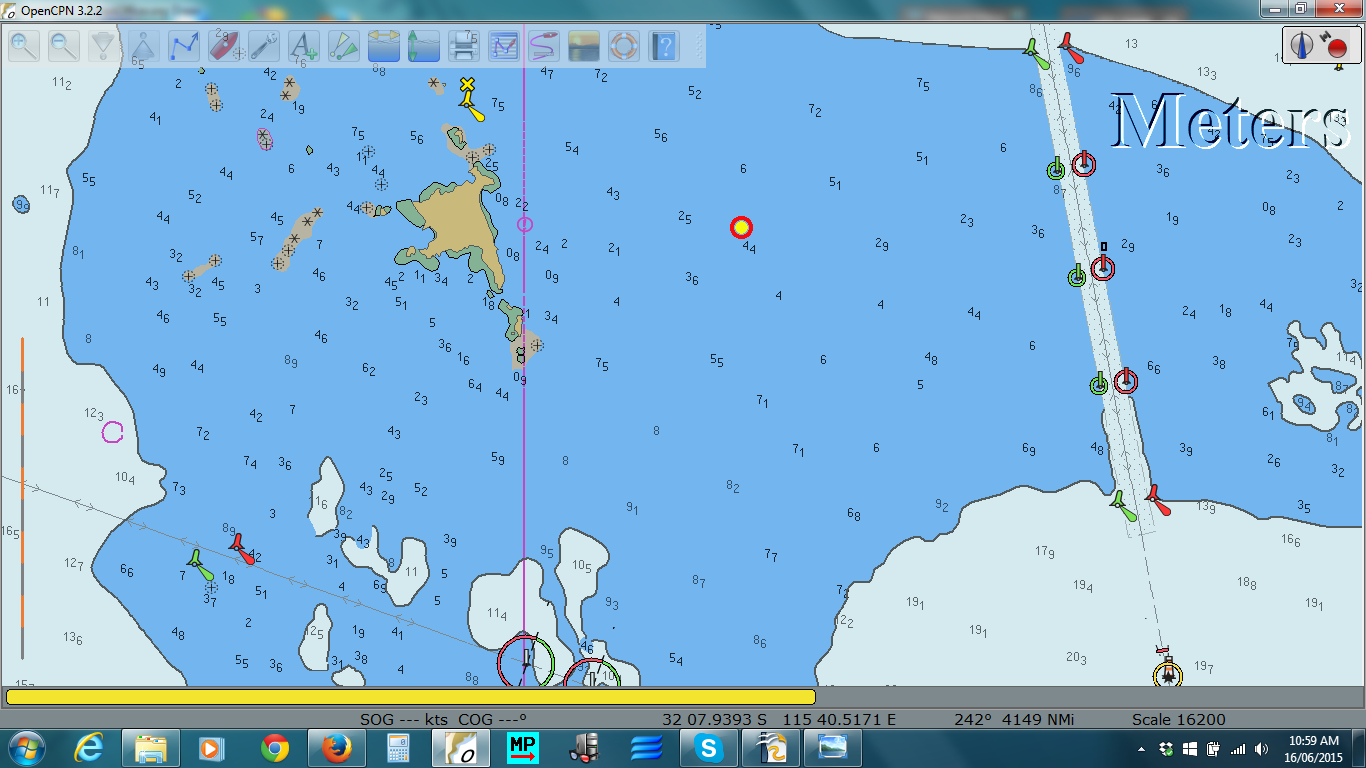
Red Circle Marks Approximate Location of Grounding

South Passage between Carnac and Garden Islands


The first image shows a closeup of the area of the grounding.  In that tide I should have been able to clear anything above 2 meters on the chart.

The second image shows South Pass, with Carnac Island to the north and the larger Garden Island to the south.  To the right is the shipping channel.   The two circled leads mark the deepest route through the pass.  Sail boats can normally pass between the line of those leads and the rocks just south of Carnac Island.

Saturday, June 6, 2015

Gas System Finallyt Working, and Short Sail

I reported last January that the boat's refurbished LPG gas system was up and running OK.  Unfortunately during the Bunbury Cruise I discovered that the gas cutoff solenoid was not working properly, ie it always allowed gas to pass through regardless of the state of the gas detector.  This meant that the boat had no emergency gas cutoff.  This surprised me because the solenoid had been working OK before the refurbishment and I could still hear it clacking on and off according to the dictates of the detector.   I can best describe the problem with reference to the following photograph of the final setup with the new solenoid.
Final Setup with New Solenoid

The gas flows from right to left.   The LPG cylinder to supply gas to the boat will be set by the green selector valve.  The gas will then pass through the black solenoid switch with the brass cutoff valve above, then through the two-stage pressure reducer and on to the galley.

In the old setup the solenoid cutoff was positioned to the left (ie downstream) of the pressure reducer.  When assembling the new system I realized that this made no sense because if the pressure reducer developed a leak from, say, a ruptured diaphragm, the gas detector would cut off would not stop the leak.  The sensible thing was to put the solenoid one step forward, between the pressure reducer and the selector switch.  I did this but the surprising result was that the solenoid was never able to cut off the gas and it took several visits to Gas Components in Canning Vale to solve the mystery.

The boat's original gas cutoff had not been designed to deal with the relatively high pressures at the cylinder.  In order to make it work the original installers had placed the cutoff downstream of the pressure reducer where the pressure was low.  Yes, this worked but was totally illegal and highly dangerous.  A gas leak from the reducer could very easily have led to a buildup of gas in the bilge, then up into the cabin.  A flick of the bilge pump switch or a spark from trying to start the stove could have blown the boat to smithereens.  The company sourced the appropriate cutoff from their Queensland branch at about 4 times the cost of the low pressure version. 

This is another lesson in not accepting everything on a professionally built boat at face value.  There was a similar trap in the irresponsible wiring to the windlass battery that caused that major electrical fire in the Sea of Cortez that could very easily led to the loss of the boat with Brenda and I in the water.


The last two photos show the final setup, with the selector switch easy to reach and the solenoid cutoff and its wiring safely tucked away.


Last week Paul and I went for a sail.  We got off to an early start and were looking forward to a full day of sailing.  We sailed into a stiff northerly breeze and a rising sea where Paul got good training on reefing and what can go wrong in heavy weather when the skipper makes mistakes.

The anchor jumped off the roller in the pounding sea and we were forced to ship it with great difficulty then lash it to a bollard near the mast.  We also had unnecessary leaks because I had forgotten to tighten down the forward hatch and blank off the vent above the head.  At noon we brought down the mainsail and gybed the boat to return to the marina under headsail only.  I got lazy and tried to make the gybe with the headsail still 25% rolled out and managed to get a nasty sail wrap so that we could roll the sail neither in or out.  We got out of that jam the hard way by untying the sheets and winding them back from around the sail., but as a result we ran out of furling line well before the sail was fully rolled up.  We made do by doing a rough job of holding the excess sail to the forestay and were able to sort out the problem at the marina.

This was all due to lack of practice on my part.  The only sails I've made on Pachuca since the end of the circumnavigation 2 years ago have been on the annual Bunbury Cruise, made at the optimal time of year. 

Anyway, it was good training for Paul and a good reminder to me about preparing the boat for rough weather.


Saturday, March 14, 2015

Bunbury Cruise 2015 Report

The following is an article that I've written for publication in the Fremantle Sailing Club's magazine "Blue Water Bulletin".  For those interested, it gives a comprehensive account of this year's Bunbury Cruise.  I've added a few photos taken by myself and others.

My role as coordinator took probably 100 hours of my time, but the reward was in the achievement of my goal of putting something back into the club after all that it has done for me.  There was another more personal reward: it forced me out of my normal Forrest Gump posture of background anonymity into a more socially active role associated with being "cruise captain" and representative of the club.  Meeting new people and remembering their names has never been my forte, but in my early 70's I'm having to get better at it.

Do not be concerned about my running aground in approaching the MOFSC on 4 March.  The approaches have been silting up while there is a battle raging over who is responsible for keeping the channel clear.  For me it was a soft grounding and I managed to back the boat out and enter the marina on the "wrong" side of the marker.

-----------------------------------
Pachuca at Dawesville

Peacefully Anchored at Busselton

The Bunbury Cruisers at Augusta Marina

Panorama of Anchorage at Koombana Bay (Busselton)
Making a Point to Ron and Marlene

Tangled Fishing Line (won 1st prize for a pike)

Approaching Koombana Bay, Bunbury

Cooking BBQ Breakfast
With Brenda for Lunch at Parade Hotel
The Bunbury Cruise 2015
by Robert Morales

Yachts from four clubs participated in this year's Bunbury Cruise – five from Fremantle Sailing Club, three from Hillarys Yacht Club, two from South of Perth Yacht Club, and one from the Mandurah Offshore Fishing and Sailing Club.  Unfortunately two other entrants were forced to withdraw.

The cruise began with the pre-cruise dinner at the FSC restaurant on Friday 13 February.  This was followed by the Skippers' Briefing in which special attention was paid to the draft of the approaches to MOFSC, the re designed entrance to the Port Geographe Marina, and the state of the moorings at Quindalup.

The departure was delayed by one day due to strong winds, and the fleet of 9 boats set off from FSC on Sunday 15 February.  The boats were:
    Alyssa Lee (FSC)
    Diva (FSC)
    Georgia (HYC)
    Hannah Rose (FSC)
    Leola (SOPYC)
    Pachuca (FSC)
    Rumtum (SOPYC)
    SANA II (HYC)
    Stealaway (FSC)
Two boats were already in position at MOFSC:
    de la mer (HYC)
    WIM (MOFSC).

At the end of that day all boats were safely berthed at MOFSC except for Pachuca, whose skipper decided to make for the Dawesville Channel due to concerns about navigating his 2.4 meter draft boat through the approaches to MOFSC in a falling tide.

The following day the entire fleet made the passage to Koombana Bay at Bunbury for an enjoyable 4-day visit..  During that passage from MOFSC to KB Rumtum picked up a cray pot which it managed to cut free while on the move.

On Friday 20 February nine boats made the passage to the Geographe Bay Yacht Club near Busselton for a 2-night stay.  Hannah Rose had returned to Fremantle as planned and WIM had retired due to a battery charging problem.  It was a pleasant stay with walking visits into Busselton and a BBQ at a public facility overlooking Geographe Bay.  Alyssa Lee proceeded to Quindalup a day early.

On Sunday 22 February the fleet made a fast passage to Quindalup in a brisk SE wind for a 3-night visit.  The Dunsborough Bay Sailing Club was as welcoming and pleasant as always, and there were no problems with the security of the moorings.

On Wednesday 25 February eight boats set off for a 2 night stay at Port Geographe Marina.  SANA II retired as planned due to an HYC club commitment. 

Craig, the PGM manager, expressed delight at all of the boat registrations being submitted well before the fleet's arrival.  “This is the way it should be done.” he exclaimed.  And to PGM's credit, all of the BC boats were allocated spacious berths together at the end of H jetty near the club house.  There were also two PGM staff waiting at the jetty to take the lines of the first arriving boats.

That evening there was a very enjoyable gathering at Dennis and Kitty Gee's home on one of the canals.  Dennis and Kitty always lay on a splendid BBQ feast and the warmest of hospitality with amazing ease and grace.

The next day was dedicated to the bus trip along the scenic route to the Boranup Gallery, on to the new marina at Augusta, a short visit to the “water wheel” near the Cape Leeuwin light house, then a leisurely lunch at the Augusta Hotel followed by 30 minutes of private time for shopping.

On Friday 27 February six boats made the passage to Koombana Bay for a leisurely and relaxing 5 day visit.  Alyssa Lee returned to Fremantle and Georgia departed for Quindalup for its usual extended stay in Geographe Bay.  The highlight of the visit was the very good live entertainment provided on Saturday night by Stuart Thompson, Commodore of KBSC, singing at the head of his mellow rock band.  (When I had spoken with him the day before he was in Dubai and he had landed in Oz at 4 AM this very day.)

On Wednesday 4 March the six boats made the long passage to MOFSC for a 2 night visit.  Pachuca arrived shortly after noon at mid tide and ran aground in 2.1 meters of water on the starboard side of the yellow traffic separation buoy at the marina entrance.  On Thursday evening was the end-of-cruise dinner.  All were happy to see Jim & Margaret Putt (Morning Tide), David & Joanne George (Alyssa Lee), and Brian & Rita Buzzard (SANA II) arrive for the dinner by car.  Rick and Theresa Oswald from MOFSC completed our dinner group of 21 persons.

The dinner marked the official end of the cruise and on Friday 6 March five boats departed for their various destinations.  Stealaway remained at MOFSC pending repairs to a water pump.

The skies during the 22 day cruise were clear, except for the day of the bus trip which was cloudy with the occasional shower.  The winds were generally good to excellent, other than one breezy night at Koombana Bay.


Friday, February 6, 2015

Ready for Sea

After putting the steering wheel back on, which I had removed in order to do the gas supply work in the lazarette, I went through my pre-cruise check list.  Other than the short rides to and from the hardstand, the boat had not been out in the water since last year's Bunbury Cruise, so I could not take anything for granted.

I ticked off the following:

- Chart Plotter OK
- Radar OK
- AIS OK
- Trimble and Lowrance GPS's OK
- Autopilot OK
- Wind Speed Instrument OK
- Wind Direction Instrument OK
- Depth Sounder OK
- Engine levels OK (Topped up the coolant)
- Engine start and run (in gear, 1100 rpm to full temperature) OK
- VHF radio OK (Got radio check from station VN6DI)
- Navigation Laptop charge from boat's 12V OK
- USB Hub (which allows 2 GPS's to be connected to 1 laptop USB port) OK
- GPS antennas for laptop OK
- Marine Plotter and OpenCPN laptop navigation software OK
- Marine Stove OK
- Refrigerator OK
- Marine Head OK
- All winches clean, lubricated, and OK
- Diesel fuel tanks full and OK
- Water tanks full and OK

I'll check the HF radio during the cruise.  I will not be using the Pactor III modem.

I won't be certain about the headsail and mainsail until I deploy them, but they are both in excellent condition and I expect no problem from them or their lines.

Today I brought two items of equipment up to date.

My flares were years out of date so I purchased a standard pack of 2 orange smoke and 2 red parachute rocket flares at a cost of $110.

The 406 MHz EPIRB beacon that I had purchase in New Zealand seemingly a lifetime ago expires this very month, so for $309 I purchased an Australian made Safety Alert model SA1G EPIRB, which boasts a battery life of 10 years, GPS accuracy of 3 meters and a transmit time of at least 3 days. 

All major boat systems seem the be OK (I write while knocking hard on the wooden desktop!) and I declare the good ship Pachuca ready for sea.


Assembling the New Dinghy

On Tuesday I spent about 2 hours wrestling with the new inflatable dinghy trying to assemble it on the foredeck.  In the end I had to give up on my goal of a complete assembly due to the short space between the life raft and inner forestay, the heavily curved deck, and worst of all, those two bollards along the center of the deck.  I managed to fit floor sections 1 and 2 at the forward of the dinghy and  sections 3 and 4 at the aft end, but could not come even close to lining up sections 2 and 3 so that I could snap them into place. 

I do not want to sail long distances with the assembled dinghy either on deck or towed behind the boat, so my plan is to assemble the dinghy on deck with only sections 3 and 4 of the aluminum floor.  This will be enough to support me on a ride to shore, where I will the fit sections 1 and 2.  With the dinghy fully assembled I'll then return to the boat to pick up Brenda and whoever else may be sailing with me.

In the forthcoming cruise we won't need the dinghy until we reach Koombana Bay, Bunbury.  I'll then assemble the dinghy and we'll tow it around the short distances of Geographe Bay.  Then on our second visit to Koombana Bay I'll ship the dinghy, break it down, and stow it for the long sail to the marina at Mandurah.

If this plan works the reward will be a large dinghy with a super strong aluminum floor, capable of getting us to our destinations with dry bottoms, dry cargo, end even dry feet.  ... IF!

Galley and Plank Finished

A few days ago Paul delivered the lids of the refrigerator and icebox which he had covered with stainless steel.  He did a fine job and fit is very good.  Note that the s/s surfaces fit into a rim of wood, which I plan to sand and varnish before the end of summer.
Note the s/s barrier in front of stove

Square tube barrier between sink and fridge

I had earlier picked up the s/s barrier made by Bret Snedden of Custom Sheet Metal in Midvale, the same man who had produced the counter top sheeting.  Bret made the barrier from 20mm square tubing and the length was to within 0.5 mm length of my specification and the fit was perfect.  The barrier prevents water from running from the sink area across to the refrigerator compartment.  Two days ago I bedded the barrier onto silicone sealant and screwed it down with two s/s pan head screws.

Boarding Plank
I also tried out the new boarding plank and it has been a big success.  The beauty of the system is that it uses the aluminum boarding ladder that was made for Pachuca in Port Townsend, USA.  Whenever we are cruising and want to go over the side for either a swim or to board the inflatable tender, I'll simply undo the ropes holding the wood plank (of 18mm marine ply) to the ladder and stow it away.  I'll also remove the two bolts holding the piece of timber at the curved end of the ladder and stow that piece too. 

The photo of the plank was taken at moderately high tide, but the plank comes into its own when the 1-meter tide is low, lowering the boat to the point where even I have trouble getting on and off.  At such times the ladder will be at a steep angle of perhaps 30 degrees.

The plank will be fixed at the boat end and slide over the jetty as the boat moves around.


Sunday, January 25, 2015

New Inflatable Dinghy

A troll through the internet confirmed what I had learned the hard way about inflatable dinghies: It is the glue and not the material that fails over time.  The material can be easily patched but once the glue degenerates the dinghy is a write off.  I've got a Bombard and a Zodiac stored below my verandah for disposal to prove it.  The Bombard was in great shape when I departed on the circumnavigation in 2008.  In the six years of storage in cool, dry, protected environment of the garage the glue degenerated spontaneously.

Dry Run

Last week I purchased an Aristocraft "Bayrunner" inflatable with seams that are hot welded rather than glued.  Like most things, the dinghy is made in China, but I am putting my hopes in the PVC material that is sourced from Germany. 

The vaunted Hypalon material for inflatable dinghies is not amenable to thermo welding because it is rubber based.  Dupont must have seen the writing on the wall because it ceased production of Hypalon in 2012.  The future seems to be thermo welded PVC.

Because the instructions were execrable even by Chinese standards it took Brenda, Stephen, and myself a full 3 hours to assemble the dinghy.  After 2.5 hours I gave up and declared that Youtube was our only hope.  Sure enough we found videos on the Web that showed us the way.

The dinghy is heavy at 52 kg (114 lb) but the weight is distributed over two bags, one for the dinghy itself and one for the aluminum floor.   Installing the aluminum floor is a bit of an effort, but the result is superb and I am looking forward to our first ride in it. 

I wanted the 2.7m version, but they were sold out in the Perth area with no hope of one until March, which is much too late for the upcoming Bunbury Cruise.  So I asked for the 2.4m version (the same length as the Zodiac) but it too was sold out.  I had to settle for the 2.9m (9' 6") version, and the salesman knocked off $100 to make me feel better,  making the total cost $1250.

Blog Archive

Contributors

Statistics Click Me