This blog began in late 2006 with the planning and preparation for a circumnavigation of the world in my 39-foot sail boat Pachuca. It then covered a successful 5-year circumnavigation that ended in April 2013. The blog now covers life with Pachuca back home in Australia.

Pachuca

Pachuca
Pachuca in Port Angeles, WA USA

Saturday, March 26, 2016

Removed Monitor Wind Steering

During the Bunbury Cruise I had a flash of insight that though obvious now took me years to arrive, probably because I am so attached to the Monitor wind steering and consider it part of the boat.

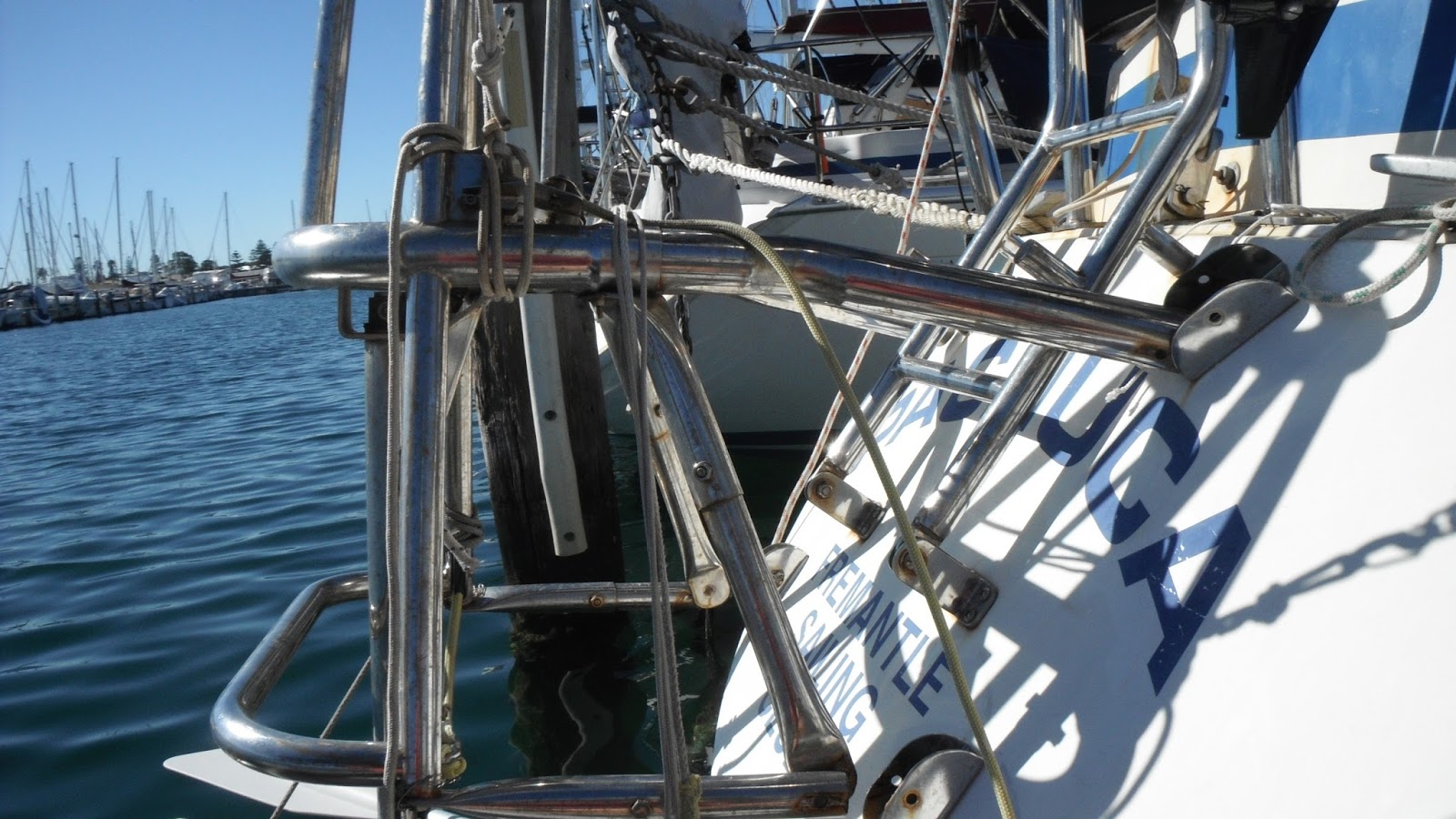
Wind steering requires the dedication of the stern of a boat for the purpose.  This presented the following disadvantages on Pachuca:
  1. The stern boarding ladder could no longer be used.
  2. The davits could no longer be used
  3. Added length to the boat
  4. Was a minor problem when towing the dinghy in a following sea.

In Port Townsend I had an aluminum boarding ladder fabricated that can be fastened anywhere along the side rail, is very strong, and goes deep into the water.  It's a great ladder that now has a second role as a superb boarding ladder for getting on and off the boat when she is in her pen.  However, the ladder takes some effort to set up and remove, and one must pass over the wire rails to use it.  The stern ladder is always in position, can be easily lowered into the water, and can be easily used because it is actually part of the rail.

The davits are useful for lowering and raising the outboard motor when configuring the inflatable tender.  To date I've been forced to carry the outboard motor over the side rail before carrying it down the, then reversing the process before towing the tender.

The increased length of the boat, small as it is, has been an issue at Port Geographe Marina that measures the LOA of boats to the nearest tenth of a meter.  Twice I was assessed at over 12m LOA, forcing me to pay for a 15m pen.

When towing the tender in a following sea it would surf into the back of the boat, slamming into the Monitor's water vane.  No damage was ever done, but the noise was irritating.
Monitor Supported by Davits


Hanging Free on Davits

Lowered Onto Dinghy

Anyway, I realized that I had not used the Monitor since returning to Australia, since the autopilot is adequate for short coastal cruises.  I had a look at the unit and confirmed that only 4 bolts held it to the boat.  The problem would be in handling it weight.  It didn't take long to come up with a plan which I executed with no problem.

I towed the inflatable dinghy all of the way back to the pen at the club.  Brenda and I were both tired after the 3-week cruise so I left the dinghy snuggled overnight along the side of the hull.  The next day I placed the dinghy along back of the boat underneath the Monitor, removed the water vane, held up the unit with the davits, then removed the 4 bolts. I then gently lowered it onto the aluminum floor of the dinghy.  I then motored to the  other side of the marina and then transferred the Monitor to the X-Trail SUV.  I also put the outboard motor into the SUV so that I could flush it at home then hosed down the tender, deflated it, then rolled it up and carted it back to the boat. Everything went like clockwork - the plan was good, I stuck to it, and as always I was able to concentrate better when working alone.

The Monitor is now in the garage ready for a cleanup, polish, and a close inspection of all of it components.  I have a good spares kit on hand and if needs be can order parts from Scanmar in the USA.


Tuesday, February 2, 2016

Marking the Chain

Yesterday I laid out the 39 meters of 10mm chain and marked it at - meter intervals.

The 10 meter mark is 3 links painted black. 
The 20 meter mark is two sets of 3 blank links separated by 2 links painted white.
The 30 meter mark is three sets of 3 black links separated by 2 links painted white.
The intermediate 5 meter marks are 2 black links. 

I've seen guys using spray paint for the markings but I figured that hand painted enamel paint would be more durable.  Also, I surrounded the black markings with white to enhance the visibility.
30 m and 20 m markings

Intermediate 5 m markings
End of Chain Marker
I'll be able to put out 35 meters of chain.  Soon after the 35 meter mark will be series of 9 black links which acts as a stop sign to paying out more chain. 

I'll swap it with the newly galvanized but unmarked 30 meter chain currently on Pachuca.

Sunday, October 18, 2015

Day Sail

On Thursday 8 October I took Paul Jr and his uncles Stan and "Celi" for a day sail to Garden Island.  Stan and Celi were over from England to attend the funeral of Paul's father, the man who had renovated the interior of my house and had died suddenly from a massive heart attack.

My master stroke was to book one of the Club's moorings on garden island.  The club owns 8 moorings, freely available to its members, with 2 each at Garden Island, Woodman Point, Rockingham, and the Swan River (which is unavailable to me because of the bridges). 
Paul, Celi at the Helm, Stan on Right

Lunch Time

Paul and Stan

On the Mooring

We met at Fremantle for breakfast at 7 AM (on Paul) then motored out of the marina in light airs at about 9 AM.  Soon we had the headsail up, sailed to the shipping channel, then motored into the wind along the channel to clear the Parmelia and Challenger Banks.  Before clearing the channel we dropped all sail and motored to the mooring, locating it by the its GPS coordinates and photographs provided by the club. 

Once we were secure on the mooring we had a splendid lunch the while Celi and I stayed on the boat dozing off the other two swam to the island for a visit.  The photo will show how close mooring is to the island, perhaps 50 meters. 

To get back we rolled out a bit of headsail for a downwind run in front of a moderate sea breeze and were back in the marina at about 6 PM.

That was the first time that I had used a club mooring and I must say that it was enjoyable to get that close to the shore and feel secure.  The moorings can be booked for several nights and I plan to visit them all in the near future.  Naturally there is a high demand for these moorings during the summer months, particularly during weekends and when school is out, but I'm banking on being able to book the moorings at mid week, one of the perks of being retired.


Galvanizing

Two weeks ago I had Kim Jamieson splice the rope onto the recently regalvanized 30 meters of chain that I had purchased with the Delta anchor.  I then removed the plow anchor and 38 meters of chain from the boat and replaced it with the Delta anchor and chain.  On the way home I dropped the plow anchor and chain at Hartway Galvanizers.

Late last week I picked up the equipment from Hartway and got the following report:

Weight of Plow Anchor: 18 kg
Weight of Chain: 83 kg. 

The total cost @ $3.00/kg came out to $304.01 plus $30.40 GST

This came out cheaper that the $3.50 I had paid for the re galvanization of the Delta anchor's chain, which weighed 67 kg, yielding a total of $234.50 plus $23.45 GST.

The next step will be to try out the new Delta anchor on a sand or mud bottom.  I'll have one of the two Swarbrick anchors (Fisherman or Admiralty type) available with a long rode for weed and rock bottoms. 

I'll store the faithful plow anchor and its re galvanized chain in the garage.


Sunday, August 16, 2015

Delta Anchor

For years I've been thinking about trying out a Delta anchor.  The literature claims that weight for weight they set faster and hold better than plow (e.g. CQR) anchors.

Two weeks ago I was at the club and had a glance at the postings on the bulletin board while I waited for my turn at the coffee machine.  The top item for sale was a 16 kg (35 lb) Delta anchor and 30 meters of 10mm (3/8") chain with another 20 meters of rope attached to it, for $250.
Anchor, Chain, and Rope

16 kg Delta Anchor
I telephoned from Brenda's house and the man told me that he had decided to put a heavier Delta anchor on his Hans 43 and I agreed that a 16 kg Delta seemed a bit light for a 43 ft boat.  He told me that the anchor and rode had hardly been used but the chain had gotten a bit rusty from storage in the anchor well.  He reckoned that the price of a new Delta 16 kg was $330 and the chain another $1000.  I did some Google work and confirmed the price of a new anchor, but the cost of 30 meters of chain varied from just over $200 to close to $1000. 

He lived only a few blocks away from Brenda so I drove to have a look after visiting the boat and taking careful measurement of one of the links on my chain (pitch, width, wire size) because I had to ensure that the new chain would match the gypsy on Pachuca's anchor windlass.

The Delta anchor indeed looked like it had been hardly used.  The chain had superficial rust but the inside of the links showed no wear.  I told him that I had deep concern about the chain because I could not risk the welfare of the boat with anchor chain out of China.  He showed me the "PWB L" stamped on one of the links.  This was good because "L" stood for "Low Carbon".  The rope also looked very good, and that had to be worth at least $100.  I made the purchase and during a short chat afterward it turned out that his Hans 43 is berthed on the other side of D jetty very close to Pachuca, so I expect to see him around.  We both agreed that plow type anchors, including Deltas, are pretty useless over weed or rock but to my surprise he only carries only the one anchor on board because he drops anchor only in sand.  Not me.  I carry at least one Fisherman anchor on board because sometimes you must quickly toss an anchor over the side without the luxury of being able to examine and choose the bottom.

Back at the house I Googled "PWB L" and confirmed that PWB chains are made in Australia to Australian standards.  Last week I dropped the chain off for re galvanizing for about $240.  I could have gotten by with the slight rust on the chain but I could not resist the convenience having the work done before setting the chain up on the boat.

The Delta anchor is 10 lb lighter than the 45 lb plow anchor that I've been using, which will make for much easier handling at the bow.  Between the lighter anchor and shorter (30 m vs 38 m) chain the load at the bow will be much lower, making for better sailing characteristics of the boat.  The 20 m of rope will be spliced at the end of the chain so that I can move the rode from the gypsy to the drum for paying out the rope.

In the coming season I'll evaluate the setting and holding properties of the anchor as well handling the rode.  I'll also have the 38 m of chain currently in the locker re galvanized.


Notice to Mariners

The following is a message that I recently sent to the FSC Cruising Section:

About three weeks ago Kim Klaka notified me of his success in his effort to have the DOT issue a Ntm regarding changing bathymetry of the Parmelia and Success banks during winter.

See notice 48 at http://161.152.28.103:10003/pls/lweb/notice_info?p_chart_id=WA%20001
Notice 48 is at the end of the above document, and states:
------------------------------
--

48. Insert
Text CAUTION (See note 8) in positions
32° 04.28' S   115° 39.34' E
32° 07.71' S   115° 40.85' E
and text
8.  Parmelia and Success Banks are subject to seasonal shoaling, mariners are advised to navigate with caution. in position
31° 53.78' S   115° 46.60' E

------------------------------
-
I hope that this notice will find its way to the next edition of the relevant DOT charts.

 The NtM appears vague because it is dealing with a vague problem.  However, to an experienced sailor in unfamiliar waters the phrase "seasonal shoaling" will jump out of the chart in large bold lettering.


Monday, June 29, 2015

Pachuca OK

I visited Pachuca this weekend, two weeks after the grounding.  As I approached her I kept a wary eye on her water line and she seemed to be riding as high in the water as ever.  Once inside the cabin I started the electric bilge pump which began sucking air almost immediately.

So as I had expected, the boat is not taking water, and I am confident that the only damage from the recent grounding is to the anti fouling at the bottom of the keel.

Our legendary sailor Jon Sanders ran into his own boat problems during the week.  The boat that he was delivering began taking more water than the pumps could deal with in very rough seas.  There was a hole in the deck, two skin fittings (which are below the water line) failed, and there must have been another leak elsewhere.

Jon cannot be faulted because he was only delivering the boat and would not be expected to make a full survey of the vessel.  Incidentally, I had every skin fitting (aka thru-hull fitting) replaced on Pachuca at great expense before setting off around the world. 

http://www.abc.net.au/news/2015-06-28/renowned-sailor-jon-sanders-blames-huge-swell-for-yacht-rescue/6579042


Blog Archive

Contributors

Statistics Click Me