This blog began in late 2006 with the planning and preparation for a circumnavigation of the world in my 39-foot sail boat Pachuca. It then covered a successful 5-year circumnavigation that ended in April 2013. The blog now covers life with Pachuca back home in Australia.

Pachuca

Pachuca
Pachuca in Port Angeles, WA USA

Tuesday, February 8, 2011

Day 14 - Agua Verde

Roca Solitaria, at the entrance to Agua Verde
Today we got further than what we had expected - from San Evaristao 44 miles to Bahia Aqua Verde (Green Water).
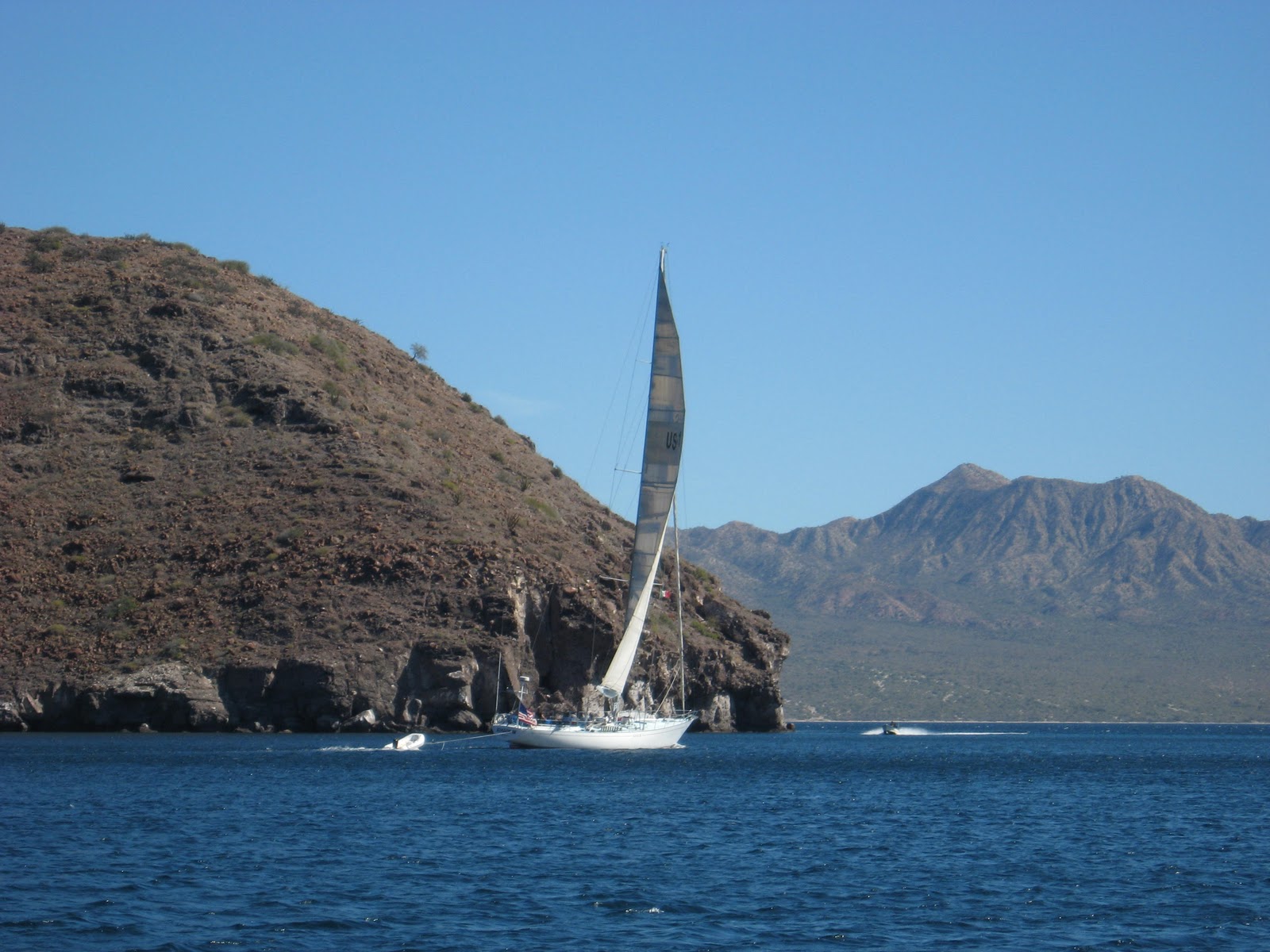
Overlooking Agua Verde, with Pachuca at anchor
With great discipline we were up at 6.00 AM in order to get an early start so that we could take advantage of the infrequent southerly winds this time of the year. We weighed anchor at 7.30 AM and motored north for two hours with a weak favorable southerly breeze. We were making between 5.8 and 6.2 knots running at 2300 rpm. Our goal was to reach Puerto Los Gatos, 29 miles away. At 9.35 AM we rolled out the jib to take advantage of what had become a moderate southerly breeze. We had an apparent wind of 14 knots and were making 4.8 kt over the ground. Ten miles from Los Gatos I suggested to Brenda that we consider taking advantage of the favorable wind and push on to Aqua Verde, another 18 miles to the north. Why not? We would pass Los Gatos shortly after 1 PM, leaving at least 4 hours in which to make the extra 18 miles to Aqua Verde. If the wind died down we could always motor. Brenda agreed and after a scare where our boat speed dropped to 3.5 kt and we actually started to head for Los Gatos the wind picked up and we were able to proceed at about 4 kt. During this leg Brenda saw a large sea turtle just a few feet from the boat as we sailed by, then spotted what she reckons must have been 500 dolphins while I has having a nap. I came out in time to see a large number of dolphins moving south, many leaping out of the water. After that Brenda reported "smoke signals from the shore" which turned out to be the spouting of whales - two of them. We could see their bodies and on several occasions saw their flukes.
We sailed until 3.45 PM when the wind had dropped and our boat speed was down to 3 kt. At this point we were only 6 air miles from Aqua Verde. We rolled in the jib and started the "iron jib" making for the passage between San Marcial Rock and Marcial Point. We got through this hazard with Captain Robert OK, given that he is prone to over navigating when in strange places.
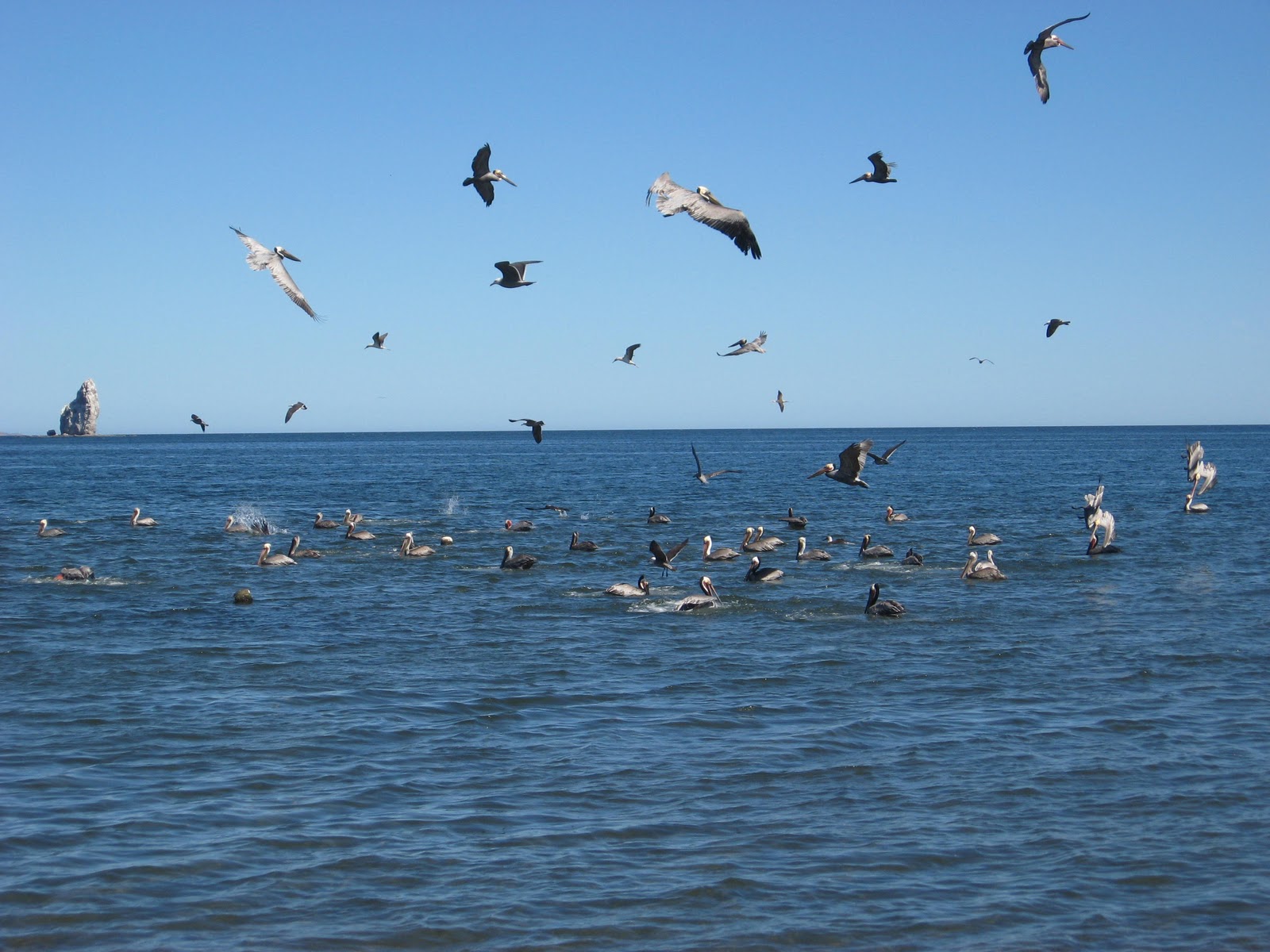
Feeding Frenzy (mainly pelicans)
Diving pelicans at work
As we closed in on Agua Verde we encountered an unexpected delay: there was a whale in the bay, spouting away. We reduced our speed and proceeded with caution. We noticed that a group of fishermen in a panga about 120 meters to our port side had also reduced their speed and were approaching with great respect. We watched the whale as it approached, eventually passing very, very close to the panga, which stopped dead in the water to allow the creature to pass. Brenda said that she could see parts of the whale both ahead and behind the panga, and it may passed under the panga.
The whale then disappeared into the 45 m depths and we proceeded into the anchorage. To the right at the northern end of the bay were three yachts in the prime position during northerly winds. To the left in a tiny bay was another yacht. The prime anchorage dead ahead was wide open for us. We saw no need for shelter from northerly winds because the wind was from the south and was expected to be light and variable the following day. We dropped anchor at 5.45 PM in 5.2 meters of water. Our position was 25N30.9, 111W04.0.
The description of Agua Verde in the cruising guide does not do it justice, in my opinion. The bay is protected on three sides, with the rugged Sierra de la Giganta in the background, sandy beaches with houses and palm trees, tents of car and kayak holiday makers in the foreground, the dramatic Roca Solitaria on the north side and the distinctive Pyramid Rock on the south side. Brenda and I are looking forward to exploring the area, finding the tienda and restaurant, and doing some hiking.
----------
radio email processed by SailMail
for information see: http://www.sailmail.com

Monday, February 7, 2011

Day 13 - San Evaristo

Fishing Panga in the morning
San Evaristo at sunrise
As promised a panga with two fishermen on board visited Pachuca this morning at 8.15 and delivered a kilo of filleted fish. The cost was 100 pesos which we think is good value for home delivery.
Soon after that the large schooner "Seaward" weighed anchor and was soon beating its way north. Not long after that two boats arrived and it was Ed on his boat and Charlie, Robyn, and Tory aboard their Moorings charter boat. Charlie and family had left Isla San Francisco a couple of hours before we did but found the going too rough for sailing and had returned. The following day they had sailed to Isla San Jose in company with Ed. Today they made the short crossing to San Evaristo.
Brenda and I went ashore at about 10 AM and we got lucky because there were people at the water desalination plant. I had brought the two 10 liter containers and immediately got them filled for 10 pesos all up. I asked him if he'd wait 20 minutes so that I could get a refill and he agreed, so I made a fast trip to the boat, poured the 20 liters into the starboard (galley) tank, then returned for the other 20 liters to be used for bathing and clothes washing. We were very pleased to get this water. 20 liters added to the water tank may not sound like much, but for us it means probably 3 more days of water for the galley. The 20 liters for bathing will also be very useful.
Then we went to the tienda where we purchased more bananas, bread, oranges, a dozen eggs, and pineapple juice. I returned to the boat with the groceries and Brenda went on a bird watching walkabout. My task during Brenda's absence was to investigate the recent electrical fire.
Robert negotiating for disposal of garbage
The damage was much more extensive than I had imagined. The cable that overheated extended from the forecastle area under the V berths all of the way to the negative bus bar in the main electrical compartment. All along its length it damaged insulation and even plastic water hosing wherever it made contact. I had to pull annealed cabling apart and patch up with tape wherever there had been a breach of the insulation of "good" wiring. Even the large water hose that passes water from the deck filler to the port tank was deeply burned, to the point where I'm not sure if it is still watertight. I plumbed the tank and it is holding an amazing 130 liters of water, which shows how little water we have been using in the head. The frayed cable appeared to be multi strand ground only, and it was connected to the negative bus bar until I removed it. The cable had one of my labels that stated "windlass cable", so it must pass under the V berths to the windlass. This surprises me because the anchor windlass is supplied with power from a small battery under the V berth, and its foot switch is supplied power from the secondary panel at the forward cabin bulkhead. The only relationship between the main panel and the windlass that I can think of is the light wiring that would be required to trickle charge the windlass battery from the central power supply.
I mentioned yesterday that the BEP voltage sensitive relay module had failed, which I learned when I manually joined the house and starter banks. Today I learned why: one of the wires to the relay module had been burnt and parted. Whether the module was a cause or a victim is to be determined. I am not an electrician, so I didn't think that a heavy multi strand ground wire could burn up under load. I thought that the lighter positive side would be the one that failed. It shows what little I know. And by the way, I have yet to find a fuse or breaker in the path of the burnt wire.
At the end of the investigation I switched on the main power switches and was happy to see that all essential systems seem to be working.
And oh by the way, I discovered during this activity that the bilge was half full of water. It took about 3 buckets full of water during the passage from Isla San Francisco. This irritated and depressed me, though it should not have been a surprise. It was to lead to a good thing.
Cantina at left, palapa at rear is part restaurant being built
I met Brenda on the beach at 1 PM and we walked over to the makeshift cantina where we were entertained by their pet goat and black dog who used his licking tongue as an instrument of ingratiation. "Man up!" I told the dog. "You've got to quit groveling and show some pride." The talk did no good, particularly since I was scratching the length of his back while I gave my sermon. Unfortunately the cantina was not having one of its better days. They had no Pacifico beer, only Mondelo. Worse, they had no ice so we had to drink the beer cool. Nevertheless Brenda enjoyed our refreshment in the company of local Mexicans, the young boy, and the goat with the large bell butting the groveling black dog.
Fishermen at work
Beach front
While sipping our beers I dumped all of my electrical and water leak problems on Brenda and out of that came a new plan, which I think may withstand further scrutiny. During the coming La Paz summer I will rent not only an apartment but also a lockup storage. I'll do what I planned to do after my return to Fremantle: empty the boat of everything that is not essential for a short stay. This includes all spare sails, provisions, spares, the boat's cusions and even Pachuca's ceiling panels. Once the boat has been stripped bare I'll replace all damaged wiring, removed every vestige of redundant wiring, and call in a professional to reinstate the BEP voltage sensitive relay as well as the flux gate compass if I haven't been able to get it going by then. But wait, there's more! I'll try to enlist the help of a friend or two to take the boat out into a rough seaway so that while others are steering the boat into the oncoming waves, decks awash, I'll go around and note every place where water is entering the boat.
On the way back to the Zodiac we ran into Charlie, Robyn, and young Tory and had a good long chat. Soon after returning to Pachuca I noticed that both Ed and Charlie had moved their boats from the north cove to the southern end of the bay, no doubt in anticipation of the change to a southerly wind.
It is predicted that there will be a weak southerly wind tomorrow. We therefore plan to sail/motor to the next anchorage. We hope to make the 29 miles to Los Gatos, with its reasonable protection from both the north and south.
----------
radio email processed by SailMail
for information see: http://www.sailmail.com

Sunday, February 6, 2011

Day 12 - First Full Day at San Evaristo

San Evaristo
Kialoa III on her way
The three boats in the north cover cleared out this morning, leaving us to share the bay with Kialoa III. I turned on the VHF radio at 8 AM and at 8.30 AM David hailed us on channel 16, and 30 minutes later we were on our way to his boat for coffee. David introduced us to his wife Kim, daughter Leona, and her partner Patrick, who are visiting from Wisconsin. David then gave us a thorough tour of his boat, both above and below deck, and described the substantial modifications and upgrades that he has planned. Kialoa III is an impressive boat, with her 18 winches, numerous "coffee grinders", and top class equipment that includes a water maker that can put out 50 gallons an hour. After a very pleasant hour of boat talk and plans over coffee and freswhly baked biscuits (scones) Brenda and I gave our thanks to David and Kim for their hospitality and bid them farewell because we knew that they had plans to sail out soon. Thirty minutes later they weighed anchor, hoisted the mainsail, then headed down the channel toward Ensenada Grande rolling out their jib on the way. The boat looked splendid in full sail. They would have had a great run with their 12 knot following wind.
Not long after that a large US flagged schooner with 8 people on deck arrived and did a circle looking for an anchoring spot. Fortunately I had made sure that the VHF radio was on because soon the boat hailed us and asked how much scope we had on our anchor rode. "Three Five Meters" was my reply, and the lady seemed satisfied with that, telling me that they also would lay down 35 meters. Soon they were anchored 75 meters seaward of us.
Shortly after lunch I discovered water in the starboard cupboard and shelving. In that short but rough sail from Isla San Francisco 2 or 3 cupfuls of water had leaked from the deck. That may not sound like much but it has a serious practical and psychological effects. If you extrapolate to the long wet conditions to be expected on the run around the Horn the situation is intolerable. I am determined to find the source of the leak during the coming summer in La Paz. That will be more difficult that it sounds because the task is not as simple as playing a water hose on the deck. I told Brenda today that I've got no problem in doing what has to be done, but my problem is in knowing what has to be done. For example, it would be extremely wasteful to re bed the toe rail if it turns out that that wasn't the problem. To find this leak I expect to have to drop the starboard side of the ceiling, empty out the contents on that side, then engage in some serious and systematic hose work, trying to simulate a deck awash, section by section.
We also got water at the forward bulkhead of the V berth area, but the source should be much easier to find now that I have removed that felt material that was lining the area. The forward hatch which Arnold and I installed in New Zealand did not leak a drop.
Tienda at San Evaristo
We then went on a walk through the village which proved very successful and enjoyable. As I expected, Brenda found this thriving fishing village picturesque against its backdrop of the rugged Sierra de la Giganta. From the boat, alert Brenda had noticed fishermen picking up the large red Humboldt squid that have invaded the Sea of Cortez in plague proportions (because their shark predators have been decimated by over fishing) that had been stranded on the beach overnight.
We found that the tienda was stocked with a good supply of fresh fruit and vegetables and we purchased bananas, potatoes, sweet potatoes, and onion. We also got a loaf of Bimbo bread and a packet of cookies. (We forgot to purchase the eggs.) We left the groceries in a cooler bag in the Zodiac and proceeded with the rest of our walk. While approaching the tienda we notice a horse and a mule tied to a rail outside of the shop. Soon a gentleman wearing a sombrero emerged and proceeded to put some serious looking spurs that he had hidden behind a bush. He mounted the mule the rode it to the door of the tienda where he was given his groceries.
Tienda patron departing
We then went to a group of fishermen and one agreed to take our garbage bag away for 50 pesos, which was good value to us.
From there we set off over the hill to look at the salt ponds on the north side of the tiny peninsula. Along the way we had a look at the school. A sign in front declared it to be a voting place this very day, the 6th of February. As in Australia, schools are used as voting venues. However, in Australia voting days are on Saturday, not Sunday. In Mexico, however, Sunday makes sense because the standard work week is 6 days long. That's right: the stereotype of the lazy Mexican spending the day sleeping under his sombrero has been replaced by a standard six-day week in this emerging market economy.
We then walked back to the south end of the village where I asked a pescador if he had any fish for sale. By then the fish had been packed in ice ready for transport so he didn't have any available but he said that he would deliver fish fillets to our boat at 8 AM tomorrow. I'm sorry that I didn't ask for 2 kilos instead of 1.
The only failure was that the palapa that acts as bar and restaurant was closed, no doubt because this is Sunday. However, we'll be back and hopefully have a meal there. We also hope to get some water from the desalination plant tomorrow.
----------
radio email processed by SailMail
for information see: http://www.sailmail.com

Day 11 - San Evaristo With Drama

Yesterday we made the 9 mile crossing up wind along the San Jose Channel to San Evaristo, a fishing village on the Baja peninsula. San Evaristo represents the extent of my experience in the Sea of Cortez because this is as far as Arnold and I got way back in April or May of last year before we were forced to motor back to La Paz with a crippled engine in a cloud of black smoke.
The day started off with another marine head problem - actually a continuation of the previous day's. I won't go on about it other than to say that this time it was a true blockage (which had probably caused the previous day's inversion of the joker valve) and because I could not uncouple the hose at the hull end without damaging it I was forced to go over the side and clear the blockage with a long screw driver up thru-hull fitting. The culprit was toilet paper (clouds and clouds of it) and the new policy is that no more paper passes through the toilet.
We motored out of the anchorage of Isla San Francisco at about noon. I was not too comfortable with the situation because we could see white caps along the San Jose Channel. Brenda made a great decision to lock down the forward hatch to it's "tight" position - so tight that I had to go topside and push the hatch down while she turn the four latches. I made a poor decision to tow the Zodiac close to stern on a bridle, though I was wise enough to ship the outboard motor. The Zodiac was to cause a lot of problems as it jumped about and tangled with the Monitor wind steering. Another poor decision was to leave the spare anchor assembled and resting on the open anchor well with the chain hanging over the side and coming in under the pulpit rail. After dropping anchor I noticed that a loop of several feet of chain had dropped into the water. Also, I didn't like the way that spare anchor cluttered up the area where I was handling the main anchor.
We tried sailing and that turned out to be yet another mistake because the leeway was driving us south rather than toward our intended northwest. With great difficulty I rolled in the half of the jib that we had been using then we headed north up the channel, engine at 2500 rpm, making 3 knots against an apparent wind of 25 knots. Then the battery alarm came on, uncharacteristically when we were running at full rpm. I noted that we were taking in only 10 amps, most if not all from the wind charger and solar panels.
Thirty minutes later the autopilot displayed "no pilot" and quit functioning. A few minutes later we got the first whiff of smoke. Brenda took the helm and by the time I got below the back of the cabin was filled with acrid throat-burning smoke from an electrical fire. I had expected the problem to be with the engine, possibly the alternator belt or maybe the alternator itself. But the smoke was coming from the corner of the navigation station, ahead of the main electrical panel and behind the Lowrance and Trimble GPS's. I turned off the master switch of the house bank and the production of smoke ceased. I lifted the cabin hatch and went outside for fresh air. A few minutes later I ventured back into the cabin and soon located the problem area, forward of the nav station bulkhead and inside the port cabin storage locker. There was a real mess spanning 2 ft of cabling, with burnt insulation and exposed wires. Brenda fretted about lack of chart plotter and depth sounder so I switched off the main breakers, turned on cabin power, then switch on one breaker at a time, feeling for hot wires. Soon we had the Raymarine chart plotter and instrumentation back on line and the front panel which supports the mast lights, anchor winch, and boat sound system were OK.
I then had a quick look at our electrical power situation and noted that the "starter" bank was at 14.2V but the "house" bank was at only 12.3V, with only a few amps going into the system. I turned the yellow switch to join both banks and immediately saw 102 amps pouring in to the batteries. The Volvo battery fault light had gone out. There is a BEP relay that is supposed to pass current to the house bank when the starter bank is at 13.7V and that had failed for some reason.
We entered the shelter of San Evaristo and dropped anchor in 6m of water at 4 PM. There were 3 boats in the snug and well protected north cove, but we elected to drop anchor in the main bay, given that the winds were expected to abate. This would place us very close to the settlement. Later I saw that two of the boats in the north cove were Murray Grey and Pacific Bliss.
I taped all exposed wires in the damage area, tidied the cabin, then knocked back two quick beers and in the evening Brenda presented a splendid meal of fritters and broccoli which we had over red wine and port. By the then the wind had died down and we had a blissfully peaceful night with the boat wandering around its anchor.
Kialoa III
At about this time David Griffin's Kialoa III, the magnificent aluminum hulled S&S built in New Zealand and winner of just about every ocean race worth noting, dropped anchor nearby. Soon David came over in his inflatable boat to say hello and invited us over for coffee the following morning.
Investigation of the wiring problem would have to wait until another day. This should not have happened if all of the wiring were fuse and breaker protected as it should be. Unfortunately I have not had a chance to review every bit of wiring in the boat. However, I will say that I have yet to note any unprotected wiring. Also, I'm hoping to get the flux gate compass back on line.
----------
radio email processed by SailMail
for information see: http://www.sailmail.com

Friday, February 4, 2011

Day 10 - Isla San Francisco


After a reasonably calm night and winds below 10 knots at breakfast time we thought that the strong winds were behind us. Shortly after dropping Brenda off on the beach for a 2 hour session of bird watching the wind picked up with patterns of quiet 15 kt winds punctuated by sudden gusts of up to 25 kt. Fortunately I had taken the precaution of removing the paddles and air pump from the Zodiac because soon the gusts were lifting up the bow of the Zodiac. Fortunately the bow line was short enough to prevent it from flipping over. I positioned the Zodiac athwartships at the stern of the boat.
The reason why I did not have a walk around the island was that the marine toilet was jammed up. This was a disappointment because I had not had any problems with it since following advice on managing the head from Alan Miell of Kangaroo Island. Fortunately most of the material had been pumped out. I prepared by clearing the floor in the head, removing the duck board, and plugging up the drain with a wad of paper toweling. Contaminated water had to be kept out of the bilge at all costs. Then I assembled the bucket, bailer, a sponge, and a bottle of bleach. I then bailed out the toilet bowl and tossed the water overboard. After this I went straight for the joker valve. There was no need to unclamp any hoses since the plastic housing with the attached hose was easily removed by loosening two screws. The joker valve is a conical piece of heavy rubber, open at one end and puckered up at the other, so that the discharge can pass one way only. I found that there was no blockage but that the joker valve had been turned in on itself so that discharge could not move out. There must have been a temporary blockage somewhere along the hose that caused enough pressure to build to force the joker valve to turn in on itself. I straightened out the joker valve, cleaned it, fit it back into position, and found that the toilet pumped well again. The next 20 minutes involved meticulous cleanup that left the head cleaner than before we left La Paz.
Charlie, Robyn, and daughter Tory
At 11 AM I picked up Brenda at the beach and was relieved to get us back on board and the outboard motor back on the rail without a mishap. The Zodiac was to spend the night athwartships behind the stern, on short lines.
Soon we had visitors. It was Charlie, Robyn, and young daughter Tory, who must be about all of three years old. My first remark was that they must be hardy souls to be venturing out in these blustery conditions. Robyn asked if I had a recent weather report and fortunately I had the wind predictions in this area through to tomorrow (Saturday) evening, when the wind is expected to be down to 16 knots. The family is from inland Alaska, north of Fairbanks, and have been visiting the Sea of Cortez for the last 4 winters. They are on a 32.5 ft Moorings charter boat. Robyn said that they were so cold last night that they crawled into bed early to get warm. I remarked that when Alaskans think that it is cold we are all in trouble. The three of them were well "rugged up", with Charlie showing me his long johns beneath his trousers. I nodded my approval as I glanced down at my bare legs beneath skimpy Australian footy shorts which I had worn on the possibly wet Zodiac ride.
Charlie and his family arrived at Isla San Francisco on the same day we did: Sunday the 30th. Since that day the same group of 6 boats has been sitting out the blow in this anchorage. There is a chance that we will be able to move on tomorrow afternoon, which will have meant 6 days in this anchorage, if the wind moderates as expected.
Our battery power has been holding up remarkably well given that in the last 5 days we have run the engine only twice briefly in order to move the boat. The house bank at present has 12.5 volts even though it has been supporting our refrigerator, electronic equipment, and lighting needs. We constantly run the refrigerator (which cycles on and off), the chart plotter, the Toshiba laptop, the wind and depth instruments, and the gas sniffer. At night we run the anchor light and of course cabin lights. Our use of the HF radio for Sailmail work at night places short bursts of demand during transmissions. Last night we also ran the external DVD drive and the boat's sound system to see the movie "Ray", the story of Ray Charles, which we enjoyed very much. In the 3 PM winter sun we are now charging a positive 3-5 amps during the long periods where the refrigerator compressor is off. The solar panels are supplying 6 amps and the Rutland wind charger must be averaging over 3 amps since during the sustained gusts it will put out between 4 and 9 amps.
----------
radio email processed by SailMail
for information see: http://www.sailmail.com
Thursday, February 3, 2011

Day 9 - Isla San Francisco, Still Windy

Narrow separation between north and south sides
It was a blustery night, with the boat being knocked from side to side. The ST60 wind instrument reported a maximum wind speed of 32 knots. I visited the foredeck 4 or 5 times during the night. For a couple of nights we had been plagued by an occasional knocking sound somewhere on the foredeck. It seemed like every time I went on deck things would go quiet. On one visit I moved the boarding ladder and oars from the foredeck to the cockpit. That didn't solve the problem so I went back up and discovered that the anchor chain was taut, working in conjunction with the snubber. It was possible that the chain was moving around as the boat swayed. I loosened the chain and we didn't notice the knocking for the rest of the little that was left of the night.
I set the alarm for 1 AM in the hopes that we would be able to hear Radio Australia and learn more about Cyclone Yasi, and we hit pay dirt. We heard the familiar introductory tune to ABC news and heard a good report on the progress of the storm which had fortunately veered to the west before it reached heavily populated areas. Nevertheless a half meter of rain was dumped in the area, causing the inevitable flooding, and there was heavy damage to the banana plantations. Afterward we heard the "PM" program with amazing clarity.
Betsy Ross Brenda at work
In the morning I brought the Mexican courtesy flag into the cabin and soon Brenda was doing a "Betsy Ross" and mending the tattered end of the flag. We'll go easy with the flag for the rest of the voyage (i.e. bring it down in high winds) and it should see us back to La Paz.
I spent more time with the Navigator software. In actually keeps track of 66 celestial objects, plus Aries. It can print 3-day pages of the nautical almanac starting at any nominated date. It would be useful to have hard copy of the almanac to cover the expected times of the approach to Drake Passage. The software has a second major facility: charting. It is possible to import scanned charts in GIF, JPG, or BMP format. The coordinates of three points on the image are keyed into the program, which will then relate it to the real world. Thereafter all sorts of chart navigation features are available. However, it is unlikely that I will exploit this feature because I'm already using Dave's excellent chart navigation package.
Broken Navman, third from right
The Rutland wind charger has come into its own in these conditions. It's output ranges from 0.5 amps during the lulls to 6 and 7 amps during the gusts. I figure that this represents at least 48 amp hours over a 24 hour period. The sky cleared last night and by noon the solar panels were contributing 6 amps. Along with the clear sky came colder temperatures. At noon the temperature in the cabin was 16.7C (62F)and Brenda and I were wearing sweaters. Brenda had her Ice Breaker merino wool skin tight pants under her blue jeans.
I happened to notice that the cover of the venerable Navman depth sounder display was so loose that was amazed that it had not fallen off. I removed it and saw the innards of buttons, wires, and electronic components. Below it were bits of the plastic fittings that had broken up. This could not have been due to trauma, since it is in a well protected area along with the other displays. I taped the cover back on and was pleased to see that it was still working. I plan to permanently seal it with epoxy after we return to La Paz. According to my records it was Feb 2010 when I installed the Raymarine ST60 wind indicator, which would mean that Arnold and I did it in Port Townsend. I thought it prudent to install an additional new depth sounder to avoid the risk of losing depth information if the Navman dropped dead in the middle of nowhere.
We spent the rest of the day on the boat. By mid afternoon the wind had calmed down somewhat. The morning's weather reports indicated that the wind would calm down on Saturday, the day after tomorrow, so we expected to spend another day at Isla San Francisco.
----------
radio email processed by SailMail
for information see: http://www.sailmail.com

Wednesday, February 2, 2011

Day 8 - Isla San Francisco Windy

Pebbly beach north of anchorage
Don Andersen's weather report this morning was pretty dire. There was a humongous high of 1045 millibars moving down from Montana toward the south, causing steep pressure gradients over the Sea of Cortez (SoC). The middle of the USA was in for some seriously frigid weather. Don talked about "storm" conditions in the northern half of the SoC with winds of over 50 knots. The southern half of the SoC could expect 40 kt winds. However, Geary of the Sonrisa net talked about 40 kt winds in the north and NW winds of 27-35 knots in the "Southern Crossing", our part of the world. The GRIB file indicated 30 kt winds in the Southern Crossing and 20 kt winds over Pachuca. Brenda and I took the optimistic view and figured that the islands in this stretch of coastline would indeed hold the wind speed in our area to about 20 knots, and that optimism turned out to be justified.
Turkey Vulture
Brown Pelican
At 9 AM things were still relatively calm so I put Brenda ashore for bird watching. I was glad to pick her up at 10.30 AM because the wind was starting to pipe up to 15 knots. As a precaution I carried the ship's fog horn in my backpack in order to belt out a loud SOS if the engine conked out at the wrong time, but fortunately the return was uneventful. Brenda reported that the conditions on the windward side of the island were pretty good, with a steady onshore wind from the north. This contrasted with the gusty conditions at the anchorage where the wind seems to whip around over and around the hill at random. The wind will calm down to 10 knots and just as Pachuca is at the end of her sway a gust of 20 knots will hit her broadside and stretch her chain. There have been no problems so far. Everything on deck is in order and the empty Zodiac is quietly riding across the stern with ropes fore and aft. I brought down the Mexican courtesy flag because it has taken a beating in the wind. Brenda offered to sew it back to health.
Blue Footed Booby
I did some useful things during the day, starting with a 30 minute reading of Mexican history and culture. Then I turned my attention to the task of installing the "Navigator" celestial navigation software on the new computer, which has become my primary navigation and communications computer. Fortunately I was able to find the license string in my black diary book. I then ported the software to this computer, wondering if it would install in Windows 7 and fortunately it installed without a problem. I then became re acquainted with the package and dug out one of the sextants and took a sun shot. This is a navigation package good beyond words. It computes into the indefinite future the almanac for more than 33 celestial objects, including the sun, moon, and planets. It reduces sights instantly then plots the lines of position relative to the assumed position of the boat. It has a superb star finding facility which includes animation at whatever speed you choose. It has a chart producing facility that I haven't explored yet. After the navigation work I grabbed my fid and made a loop on a three-strand rope that was unraveling fast.
Brenda got busy too. She tried out Sue Hoover's beer bread recipe, which required that the captain had over one can of beer from his precious stores. I was fortunate enough to be selected as a taste tester of the result and agreed with Brenda that the bread was excellent. The big advantage of beer bread is that it requires no rise time - just mix, knead, and bake.
We went into the evening expecting a slightly calmer following day. At 6 PM I poured myself a small neat Tequila and Brenda had a Tequila with Jugo de Naranja (orange juice).
----------
radio email processed by SailMail
for information see: http://www.sailmail.com

Blog Archive

Contributors

Statistics Click Me