Yesterday I had a productive and successful day preparing the engine for extraction and the crane is scheduled to arrive at 9 AM today.
I started the day by removing the 160 amp alternator which I intend to keep.
I then removed the wiring connections in two categories. The important group of wires was made up of those that may be used for the new engine, e.g. alternator, starter, temperature sensors. These I marked for the Volvo installation effort. The other group were associated with the Sabb only and I had little hesitation in cutting them at my convenience. Once the Sabb has been removed and Pachuca is back in her pen I will spend a day or two removing all Sabb redundant wiring (and any other redundant wiring that I can find).
I then removed the cooling hoses, remembering to shut off the water intake sea cock because forgetting to do this would have led to great embarrassment when we lower the boat back into the water.
Then it was time for the fuel lines. I first shut off the fuel cocks at the base of each tank and then took the time to sample the fuel in the tanks for evidence of water. There was no water but the port tank drain bowl was clogged up so I had to completely remove the screw from the base of the bowl and clear the opening by poking stainless steel tie wire into the bowl. One of Pachuca's virtues in spite of her years of neglect by the previous owners is that her fuel system is very clean so I see no need to "prep" the fuel for the new engine.
Then I removed the throttle, shut off, and transmission cables.
I had already figured out that the extraction would be much easier if we split the Hurth transmission from the engine. I went into the yard seeking mechanical help and soon one of the men was on board removing the shaft coupling. We left it at that and I started to work on freeing the engine from the six engine mounts. I had success with four of them but there were two where I needed professional help. It was almost 1 PM so I visited Marina de La Paz to arrange a visit by Joel after lunch. Eventually Neil, Joel, and I got together and it was agreed that Joel would visit the boat. To my surprise Joel had already had his lunch so he gathered up some tools and we headed back to the boat yard. Before we left his shop we opened the case holding the new Volvo and I found the box holding the PSS dripless packing so that the boat yard team could put it on when the propeller shaft was reinstalled in the boat. I took the opportunity to fondle the new engine and pat it on its heads. (The bonding process had already begun.) Neil had by then read the instructions and handed me the instructions in Spanish that he had printed out and suggested that I make sure that the installer read them carefully. I plan to do that and also oversee the installation of the PSS because I have seen the installation video twice and have a good idea of traps to be avoided.
Joel loosened the recalcitrant footings with relative ease using his socket set, though he was forced to go back to his shop to find a deep socket. We then loosened the six bolts holding the Hurth gear box and using screw drivers we split it off from the engine.
I asked Joel to run his eye over the engine to see if I had missed anything and he pronounced the engine ready for lift off. He then took out his tape measure and confirmed that the engine will fit nicely through the companionway without any need to tilt the engine. Joel then agreed to bring a pickup truck when the crane arrived so that he could take the Sabb engine away. Morning was best for him.
After Joel returned to his shop I arranged for a crane at 9 AM this morning then walked over to Joel's workshop to let him know.
I then spent another hour dropping the companionway dodger and tidying up then returned to the hotel room. I was tired, dirty, and had eaten nothing since the two pieces of breakfast toast; but I was very satisfied with how the day had gone.
Pachuca

Pachuca in Port Angeles, WA USA
Friday, July 9, 2010

Wednesday, July 7, 2010
Boat on Hardstand
At 9.30 AM Bob Carroll came on board and at 9.45 we were on our way to La Marina del Palmar less than a kilometer away. It was an easy exit because the boat was berthed bow-out and the 10 knot wind was just off the port bow, which would help me make the right turn into the fairway.

The yard wanted me to back into the lifter and as we approached the jetty we were fortunate to find three employees there ready to take our lines and turn the boat around. At precisely 9.56 AM local time I shut down the Sabb engine for the last time. Soon the boat was out of the water and on blocks still in the slings for the high pressure washing of the hull. Any misgivings that I had about antifouling the hull disappeared after a few minutes of watching the high pressure hose dislodging the barnacles and other marine growth along with my year-old antifouling. I would have preferred to have had the barnacles scraped off followed by a gentler wash but I had to accept their methods. The cleaning operation took hours, some of which was interrupted by the Spain-Germany soccer match.
I check into the office and learned that they had expected me on Friday at 10 AM. Language problem, I guess. I apologised for the mistake and fortunately my unexpected arrival had not caused a big problem.
 While Bob and I were attending to the boat Brenda went ahead to the hotel room and started setting things up. Soon after the hull washdown began I walked the short distance to the hotel (one block away) and signed a paper then visited the room. I went back for lunch, took a nap, then returned to the boat yard to find everything pretty well shut down for the soccer match. I returned to the room and watched most of the second half of the match on the small TV provided with the room. I then returned to the yard, saw the man finish the wash down, then patiently waited for over 2 hours wondering when they would put Pachuca in her position so that I could retrieve my gear and lock up the boat. During this wait I did get a chance to explain my requirements at the boat yard, and I made sure that they understood that Pachuca had to be positioned with enough room at her side for a crane. Later I spoke with someone (Arturo) who asked me to leave the antifouling paint in the cockpit because the man doing the job would start the job at 8 AM the following day.

At 4.20 PM I was politely asked why I was hanging around - was I planning to sleep on the boat? Once they understood that I needed to get into the boat they produced a ladder and soon I was inside preparing my exit. Instead of being so patient and polite I should have spoken up right away and saved myself hours of waiting.

I found the ceiling, three walls, and the marine toilet in Pachuca's head covered with what appeared to be a black soot. I figured out that the hull cleaner must have stuck the high pressure hose into the outlet of the sink and blown all sorts of strange things into the head. So a warning to all sailors: shut off all drain cocks before a haulout in Mexico if you want to avoid 30 minutes of hard cleaning.
Brenda and I had dinner at the marina (T-bone steak special) then visited the boat yard to see where they had placed Pachuca. From the fence it looked like she was still in the slings and I was not happy. Fortunately the gate was unlocked and the guard let us visit the boat. Pachuca was in fact fully on the ground with the best propping up job that she's ever had. I think that there were 5 props on each side, but I'll count them tomorrow to be sure.

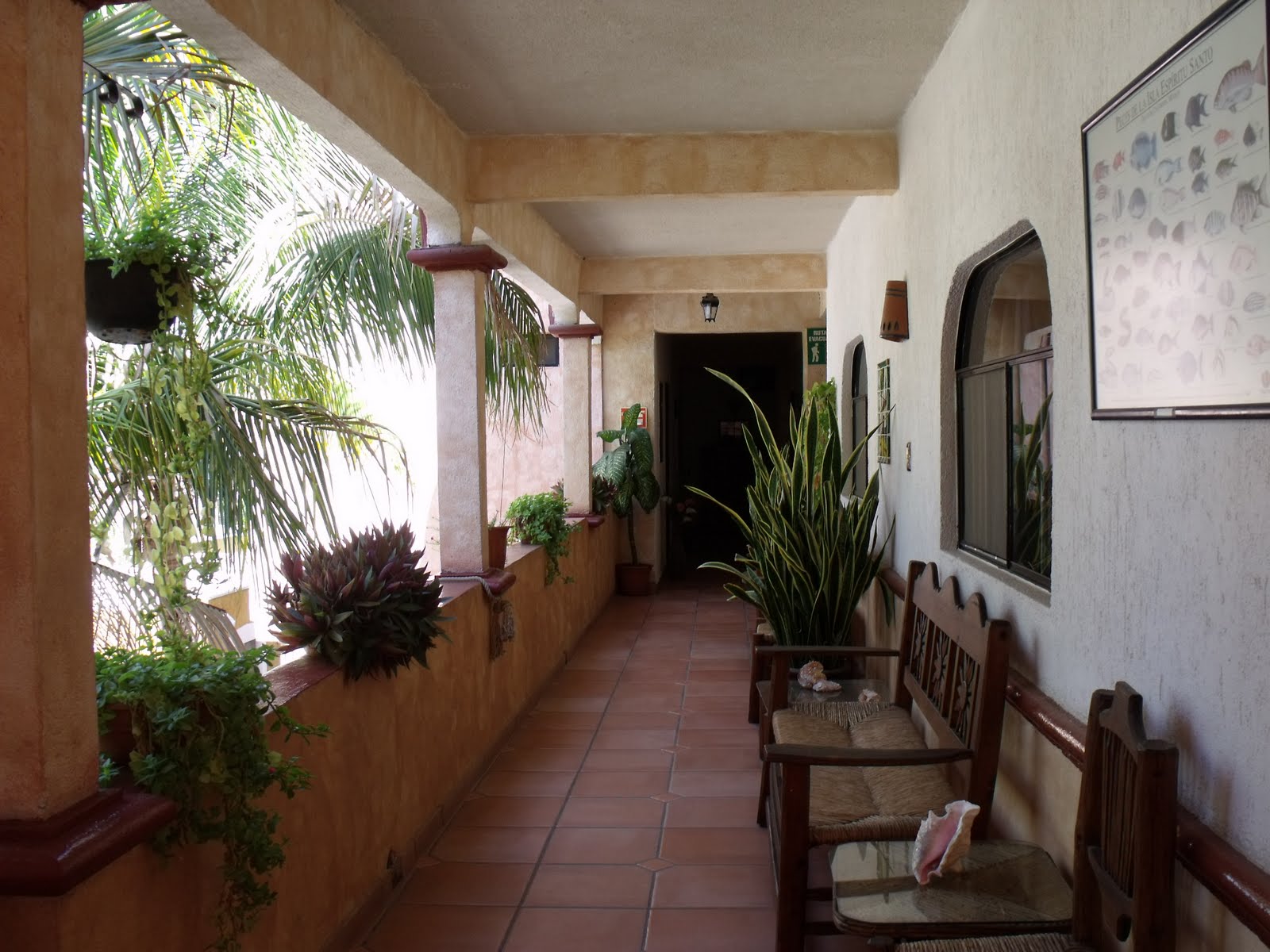
Brenda and I like the hotel very much: very quiet and out of the way, very Spanish and therefore cool, very secure, and very close to the boat yard. We have access to a communal kitchen and a wonderful palapa on the top floor with views to the Mogote and comfortable furniture including two hammocks.
The first photo shows high staffing typical of Mexican operations. In this case six people are attending to the haulout.
The last two photos show Brenda outside our room, which is at the end of the second floor. Above us is the palapa which helps keep our room cool.
Brenda's Bird of the Day is another woodpecker. It looks like the sapsucker type of woodpecker with white wing patches but does not seem to make an appearance in the Bird Book - 'National geographic Field Guide to the Birds of North America' which does cover as far south as this part of Mexico. These birds seem to favour coconut palms and they fly between them landing on the trunks and disappearing under the fronds. Have noticed several of them over the past few days. Robert was interested to find that Yellow-bellied Sapsuckers really do exist and are not just an invention of comedy routines in the fifties.

The yard wanted me to back into the lifter and as we approached the jetty we were fortunate to find three employees there ready to take our lines and turn the boat around. At precisely 9.56 AM local time I shut down the Sabb engine for the last time. Soon the boat was out of the water and on blocks still in the slings for the high pressure washing of the hull. Any misgivings that I had about antifouling the hull disappeared after a few minutes of watching the high pressure hose dislodging the barnacles and other marine growth along with my year-old antifouling. I would have preferred to have had the barnacles scraped off followed by a gentler wash but I had to accept their methods. The cleaning operation took hours, some of which was interrupted by the Spain-Germany soccer match.
I check into the office and learned that they had expected me on Friday at 10 AM. Language problem, I guess. I apologised for the mistake and fortunately my unexpected arrival had not caused a big problem.

At 4.20 PM I was politely asked why I was hanging around - was I planning to sleep on the boat? Once they understood that I needed to get into the boat they produced a ladder and soon I was inside preparing my exit. Instead of being so patient and polite I should have spoken up right away and saved myself hours of waiting.

I found the ceiling, three walls, and the marine toilet in Pachuca's head covered with what appeared to be a black soot. I figured out that the hull cleaner must have stuck the high pressure hose into the outlet of the sink and blown all sorts of strange things into the head. So a warning to all sailors: shut off all drain cocks before a haulout in Mexico if you want to avoid 30 minutes of hard cleaning.
Brenda and I had dinner at the marina (T-bone steak special) then visited the boat yard to see where they had placed Pachuca. From the fence it looked like she was still in the slings and I was not happy. Fortunately the gate was unlocked and the guard let us visit the boat. Pachuca was in fact fully on the ground with the best propping up job that she's ever had. I think that there were 5 props on each side, but I'll count them tomorrow to be sure.

Brenda and I like the hotel very much: very quiet and out of the way, very Spanish and therefore cool, very secure, and very close to the boat yard. We have access to a communal kitchen and a wonderful palapa on the top floor with views to the Mogote and comfortable furniture including two hammocks.
The first photo shows high staffing typical of Mexican operations. In this case six people are attending to the haulout.
The last two photos show Brenda outside our room, which is at the end of the second floor. Above us is the palapa which helps keep our room cool.
Brenda's Bird of the Day is another woodpecker. It looks like the sapsucker type of woodpecker with white wing patches but does not seem to make an appearance in the Bird Book - 'National geographic Field Guide to the Birds of North America' which does cover as far south as this part of Mexico. These birds seem to favour coconut palms and they fly between them landing on the trunks and disappearing under the fronds. Have noticed several of them over the past few days. Robert was interested to find that Yellow-bellied Sapsuckers really do exist and are not just an invention of comedy routines in the fifties.
Monday, July 5, 2010
Volvo Engine Has Arrived
 The new Volvo engine is now in the workshop of the Marina de La Paz.
 Given the delays of the last three weeks the speed of the final delivery of the new engine took me by surprise. At about 10 AM I picked up an email message from Ada notifying me that the engine had arrived and asking for the delivery address. I visited the marina office to explain the situation and was told that they would have the engine delivered to the workshop when the truck arrived. I was happy to leave it at that but fortunately ran into Bob Carroll who suggested that we visit the workshop and advise Joel. We did this and Joel picked out a place for the box when it arrived. On Bob's advice I then asked Adriana at the office to notify me on VHF 22 when the truck arrived. As soon as I got back to the boat I explained the situation to Brenda then turned on VHF 22, not expecting to hear anything for hours. I then sent a message to Ada giving her the delivery address and asking about method of payment.

 At the office I explained the payment issue to Adriana and offered to accompany the driver back to the Columbia office to pay by Visa card. This was accepted and soon I was on the way to Columbia in a nice air conditioned truck. There I met Ada where we actually spent most of the time discussing jelly fish around La Paz and in Australia. Nevertheless the payment was made and I gave the OK to pay the 3.6% Visa card fee. I asked Ada to pass on my thanks to Judith for her help. As far as I could see, Columbia Transport had been professional in every way and the problems encountered had been with the Customs bureaucracy. The Columbia driver then brought me back to the marina.
The original quotation had been $1085.76 USD for the forwarding fees, freight insurance, freight, and 11% IVA tax for the services. Neil had seen the quotation and suggested that I query the 6% services fee because certain services on the list would not be required. The upshot is that the final bill came in at $742.90 USD, $342.86 USD lower than the original quotation. I reported this to Neil by email and thanked him for his role in saving me so much money.

I ran into Neil in the office and he seemed as happy as I was about the engine arrival. The plan is for me to motor Pachuca to La Marina del Palmar on Wednesday, the day after tomorrow, and have the boat lifted out of the water. Bob Carroll will be able accompany Brenda and myself on the trip to the boat yard, which will be of great comfort to me. Bob checked and tidal currents will not be an issue that day, but I must visit Alejandro at the boat yard to make sure that there are no depth issues with my 7.5 ft draft.
The boat lift out package includes 3 days of hard standing during which I will probably have the hull antifouled, though there is some doubt about the need given what I've been told by the fellows at the coffee table. But I will definitely begin work on extricating the Sabb engine and Neil has given the OK for me to get any help that I might need from Joel for this job. (My most likely problem will be lack of tools.) Perhaps on Friday we'll be able to call in the crane to lift the Sabb engine out intacto. Once the engine is out we'll remove the propeller shaft up through the engine compartment and send it off to a machine shop for straightening.
I'll get the boat back into the water as soon as the shaft has been refitted and Neil will have Pachuca towed back to her slip where Joel will oversee the preparation of the engine bed.
We will book a room at the nearby hotel for a week starting on Wednesday and will probably remain there until the Volvo engine has been installed.
Sunday, July 4, 2010
Un Dia En La Playa


 The first photo is of the La Paz waterfront walk at 8.30 AM on Sunday morning.
Here is Brenda in the water, with Isla Espiritu Santo in the background.
This is the Playa Tecolote pub where we had lunch.
 This was our lunch scene.
This morning Brenda and I boarded the 9 AM bus for Playa Tecolote (Tecolote Beach), a 30 minute ride east of La Paz looking at the San Lorenzo Channel and Isla Espiritu Sano to the north. I could see the green and red markers that Arnold and I had to thread in our passage from Los Muertos. It is an extremely scenic bus ride along the coast that alone justifies the 26 peso one way fare.
 The good ship Orion serving as a bar.
The beach was superb, with its golden sand and gentle waves more characteristic of a lake. There was what Australians would call a pub and several other food and drink outlets. It was possible to rent kayaks and water scooters.
 Robert under a palapa
We walked to the west end of the beach to a rocky headland where Brenda had a swim while I had a snooze in the shelter of a small cave in the rock. We then walked back and had a splendid lunch under a palapa only a few yards from the beach. We had a drinks accompanied by the customary crisp fresh nachos and salsa dip. Then came the lunch of fish fillet with rice and salad.
After lunch Brenda had another short dip in the water then did some more bird (and cactus) watching. We boarded the return bus at 2.45 PM.

Brenda's Bird of the Day is a Cactus Wren. It was the only bird I saw when I walked a few hundred metres from the beach to be near a wild cactus for the first time. The Cactus Wren is a sturdy medium sized bird (nothing like Oz wrens). They make their nest in cactus plants such as the one in the closeup though it would have to be a branching plant as in the background.
 The good ship Orion serving as a bar.
The beach was superb, with its golden sand and gentle waves more characteristic of a lake. There was what Australians would call a pub and several other food and drink outlets. It was possible to rent kayaks and water scooters.
 Robert under a palapa
We walked to the west end of the beach to a rocky headland where Brenda had a swim while I had a snooze in the shelter of a small cave in the rock. We then walked back and had a splendid lunch under a palapa only a few yards from the beach. We had a drinks accompanied by the customary crisp fresh nachos and salsa dip. Then came the lunch of fish fillet with rice and salad.
After lunch Brenda had another short dip in the water then did some more bird (and cactus) watching. We boarded the return bus at 2.45 PM.

Brenda's Bird of the Day is a Cactus Wren. It was the only bird I saw when I walked a few hundred metres from the beach to be near a wild cactus for the first time. The Cactus Wren is a sturdy medium sized bird (nothing like Oz wrens). They make their nest in cactus plants such as the one in the closeup though it would have to be a branching plant as in the background.
Saturday, July 3, 2010
Maybe Monday and Small Jobs
The last I heard on Friday was a verbal assurance from Ada at Columbia Transport that the Volvo engine would go out of San Diego on Friday's truck. If so, it should arrive at the La Paz depot on Monday. (I'll believe it when I see it.)
The winches had not been serviced since Hawaii, perhaps 14 months ago, and the four big ones were getting stiff. Four days ago I began a round of servicing, one winch per day. It took me over 5 hours to do the first winch, and today's fourth winch took 3 hours. I take my time doing this work, largely because one faux paux can mean a vital component going over the side and rendering the winch useless. I meticulously clean every component using a biodegradable cleaner that I mix with water. (It's great stuff: a strong solution will degrease an engine and a weak solution will clean a sail.) I clean every gear tooth with a tooth brush as if it were one of my molars. Once everything is clean and dry I apply a thin coat of winch grease to every wearing part using a tiny brush. Of course each gear tooth gets its 15 seconds of fame under the brush.
Today I actually serviced two winches: the last of the four large cockpit winches and one of the smaller ones on the cabin, meaning that I have only one to go.
I must say that I am pleased at the state of the winches. I found all gears, bearings, etc in good working order. Given the amount of spares I have on hand and the fact that I now know how to maintain and protect them from corrosion I can't see why these not-made-anymore Maxwell winches shouldn't last through my tenure of Pachuca. They are very strong winches and have the great feature of being able to reverse the drum rotation, which I have exploited to great advantage.
Another little job that I did was to recharge the refrigerator. Using my beer temperature index of performance I detected a steady deterioration of performance of the unit, which Brenda confirmed. The likely culprit was another slow gas leak. I dug out the gas recharging kit, read the instruction on how to use it, then took out one of the four canisters of R12 gas and injected everything that I could, which meant equilibrium in pressures between the refrigerator and the canister.
The results were spectacular. In ambient temperatures approaching 100F the refrigerator was taking beer to the freezing point in about 4 hours.
I know that recharging is not a real fix but at this point all I am interested in is having the refrigerator see me through my stay in Mexico. Too much effort has already been spent in chasing down leaks. Soon after departing Mexico I will be in cooler weather and when I return to Australia I will replace the refrigerator with a more efficient unit. R12 is banned in the USA and undoubtedly Australia too, but it is legal in Mexico and very cheap. For me R12 presented a moral dilemma that shook me to my foundations: be responsible to the health of this planet that we all share, or have cold beer? It was a tough one but the 100F outside temperature was of great assistance in the resolution of my spiritual turmoil.
By the way, La Paz has had 3 days of respite from the hot weather, with the temperature running approximately from 70F (21C) to 90F (32C). One theory is that the intense low pressure of the hurricane on the east side of Mexico is drawing cool air from the Pacific ocean.
Brenda's Bird of the Day is a Tricolored Heron. This bird was at the edge of the marina this morning. He is an expert fisher and in six attempts got six little fish. One of them is on the way down in the second photo.
The winches had not been serviced since Hawaii, perhaps 14 months ago, and the four big ones were getting stiff. Four days ago I began a round of servicing, one winch per day. It took me over 5 hours to do the first winch, and today's fourth winch took 3 hours. I take my time doing this work, largely because one faux paux can mean a vital component going over the side and rendering the winch useless. I meticulously clean every component using a biodegradable cleaner that I mix with water. (It's great stuff: a strong solution will degrease an engine and a weak solution will clean a sail.) I clean every gear tooth with a tooth brush as if it were one of my molars. Once everything is clean and dry I apply a thin coat of winch grease to every wearing part using a tiny brush. Of course each gear tooth gets its 15 seconds of fame under the brush.
Today I actually serviced two winches: the last of the four large cockpit winches and one of the smaller ones on the cabin, meaning that I have only one to go.
I must say that I am pleased at the state of the winches. I found all gears, bearings, etc in good working order. Given the amount of spares I have on hand and the fact that I now know how to maintain and protect them from corrosion I can't see why these not-made-anymore Maxwell winches shouldn't last through my tenure of Pachuca. They are very strong winches and have the great feature of being able to reverse the drum rotation, which I have exploited to great advantage.
Another little job that I did was to recharge the refrigerator. Using my beer temperature index of performance I detected a steady deterioration of performance of the unit, which Brenda confirmed. The likely culprit was another slow gas leak. I dug out the gas recharging kit, read the instruction on how to use it, then took out one of the four canisters of R12 gas and injected everything that I could, which meant equilibrium in pressures between the refrigerator and the canister.
The results were spectacular. In ambient temperatures approaching 100F the refrigerator was taking beer to the freezing point in about 4 hours.
I know that recharging is not a real fix but at this point all I am interested in is having the refrigerator see me through my stay in Mexico. Too much effort has already been spent in chasing down leaks. Soon after departing Mexico I will be in cooler weather and when I return to Australia I will replace the refrigerator with a more efficient unit. R12 is banned in the USA and undoubtedly Australia too, but it is legal in Mexico and very cheap. For me R12 presented a moral dilemma that shook me to my foundations: be responsible to the health of this planet that we all share, or have cold beer? It was a tough one but the 100F outside temperature was of great assistance in the resolution of my spiritual turmoil.

By the way, La Paz has had 3 days of respite from the hot weather, with the temperature running approximately from 70F (21C) to 90F (32C). One theory is that the intense low pressure of the hurricane on the east side of Mexico is drawing cool air from the Pacific ocean.
Brenda's Bird of the Day is a Tricolored Heron.
 This bird was at the edge of the marina this morning. He is an expert fisher and in six attempts got six little fish. One of them is on the way down in the second photo.
Friday, July 2, 2010
Engine Update
I know that it has been a while since I have published anything about the importation of the new Volvo engine but there was a reason: the last 8 days have been the all too familiar roller coaster ride of surprises and uncertainty, and I didn't want to lead readers up blind alleys.
On Thursday evening of last week I received a message from Judith at the Columbia La Paz office with the good news that the shipment had been inspected and all contents had been judged to be customs free. However, another 3 or 4 working days would be required for submitting the paper work to Banjercito. Then she presented me with the choice of either waiting the extra few days or paying the full customs duty on the shipment and having it put on the truck for La Paz the next day.
To me it was an extraordinary question. I don't do business that way. I was also annoyed at being presented with this choice on the night before the truck was to leave San Diego. This is the bulk of my response:
"I know that money and time can both be important but to me principles are even more important.
Your good news confirmed that everything can be imported temporarily as I would have expected because I have fulfilled all of the conditions for a temporary importation. On principle I will not consider waiving that right because a few days might be saved.
Please do not put the engine on that truck tomorrow. See the normal temporary importation process through. All I ask is that you keep me informed on what to expect. From my understanding of your message I would expect the engine in La Paz next week, correct?"
The next day I briefed Neil and soon he was on the telephone to Judith explaining that the Banjercito paper work could have been done before the engine had even arrived in San Diego, so why were they tacking it to the end of the process?
I went into the weekend expecting it to arrive late the next (this) week.
Then on Wednesday night I received a message from Judith stating that there was some sort of problem with Customs and the paperwork and that her boss had explained the situation to Neil. Early yesterday afternoon after returning from the delivery of Estelle to the Dockside transporter I went to see Neil at his office. Neil had in fact not spoken with Judith's boss but was working on the problem when I walked in and made a phone call to the customs agent at Columbia in San Diego.
From what I understand a person from Columbia had presented my papers to Banjercito in Tijuana the day before and was told that the permit could not be given - with no explanation. The Columbia customs agent contacted the head of Mexican customs in Tijuana to find out what was going on and was told that inquiries would be made and a meeting was set up between the two for the next day, at about the time that I had visited Neil's office.
Neil passed on some information that he had picked up from the conversation. The management of the customs office in Tijuana had changed about two weeks earlier and since then there had been problems with permits not being issued. I was not the only one with a problem. Shipments were being held up and representations were being made to Mexico City by various organisations and businesses. The problem seemed to be confined to personnel at the Tijuana office.
I felt comfortable about the situation because I had the good fortune of having Neil working on my behalf at this end and Columbia, a large company of some stature at the other end. Neil has been raised in Mexico, speaks fluent Spanish, at one point ran the La Paz harbor, has various business interests, and knows a lot of people. Had I been on my own I don't think that I would have stood a chance.
Later in the afternoon Neil visited the boat twice for my signature to a letter that Columbia had requested. He told me that he would notify me as soon as he learned anything.
In the early evening I received the following message from Neil:
I have just telephoned Columbia's La Paz office and learned that the Volvo engine is not on the shipping manifest. I was speaking with Ada because Judith is in Cabos today. While we were speaking Ada got a confirmation from Judith about Andres's message that the engine would be shipped today. I told Ada that this has been going on for three weeks now and would she be kind enough to telephone the San Diego branch to find out why the engine is not on the manifest. She agreed and I am to call her back in 1 hour.
The roller coaster ride continues.
Brenda's Bird of the Day is a Silky Flycatcher with a name that does not come easily: Phainopepla. There is no photo but if you are from Oz, think of a slim Willie Wagtail with a handsome crest. The males are very shiny black all over and a conspicuous white wing patch can be seen as they fly.
On Thursday evening of last week I received a message from Judith at the Columbia La Paz office with the good news that the shipment had been inspected and all contents had been judged to be customs free. However, another 3 or 4 working days would be required for submitting the paper work to Banjercito. Then she presented me with the choice of either waiting the extra few days or paying the full customs duty on the shipment and having it put on the truck for La Paz the next day.
To me it was an extraordinary question. I don't do business that way. I was also annoyed at being presented with this choice on the night before the truck was to leave San Diego. This is the bulk of my response:
"I know that money and time can both be important but to me principles are even more important.
Your good news confirmed that everything can be imported temporarily as I would have expected because I have fulfilled all of the conditions for a temporary importation. On principle I will not consider waiving that right because a few days might be saved.
Please do not put the engine on that truck tomorrow. See the normal temporary importation process through. All I ask is that you keep me informed on what to expect. From my understanding of your message I would expect the engine in La Paz next week, correct?"
The next day I briefed Neil and soon he was on the telephone to Judith explaining that the Banjercito paper work could have been done before the engine had even arrived in San Diego, so why were they tacking it to the end of the process?
I went into the weekend expecting it to arrive late the next (this) week.
Then on Wednesday night I received a message from Judith stating that there was some sort of problem with Customs and the paperwork and that her boss had explained the situation to Neil. Early yesterday afternoon after returning from the delivery of Estelle to the Dockside transporter I went to see Neil at his office. Neil had in fact not spoken with Judith's boss but was working on the problem when I walked in and made a phone call to the customs agent at Columbia in San Diego.
From what I understand a person from Columbia had presented my papers to Banjercito in Tijuana the day before and was told that the permit could not be given - with no explanation. The Columbia customs agent contacted the head of Mexican customs in Tijuana to find out what was going on and was told that inquiries would be made and a meeting was set up between the two for the next day, at about the time that I had visited Neil's office.
Neil passed on some information that he had picked up from the conversation. The management of the customs office in Tijuana had changed about two weeks earlier and since then there had been problems with permits not being issued. I was not the only one with a problem. Shipments were being held up and representations were being made to Mexico City by various organisations and businesses. The problem seemed to be confined to personnel at the Tijuana office.
I felt comfortable about the situation because I had the good fortune of having Neil working on my behalf at this end and Columbia, a large company of some stature at the other end. Neil has been raised in Mexico, speaks fluent Spanish, at one point ran the La Paz harbor, has various business interests, and knows a lot of people. Had I been on my own I don't think that I would have stood a chance.
Later in the afternoon Neil visited the boat twice for my signature to a letter that Columbia had requested. He told me that he would notify me as soon as he learned anything.
In the early evening I received the following message from Neil:
"Good News
Andrés just sent me an e mail letting me know that he has been authorized to send the motor and will ship it tomorrow.
Keep your fingers crossed."
I have just telephoned Columbia's La Paz office and learned that the Volvo engine is not on the shipping manifest. I was speaking with Ada because Judith is in Cabos today. While we were speaking Ada got a confirmation from Judith about Andres's message that the engine would be shipped today. I told Ada that this has been going on for three weeks now and would she be kind enough to telephone the San Diego branch to find out why the engine is not on the manifest. She agreed and I am to call her back in 1 hour.
The roller coaster ride continues.
Brenda's Bird of the Day is a Silky Flycatcher with a name that does not come easily: Phainopepla. There is no photo but if you are from Oz, think of a slim Willie Wagtail with a handsome crest. The males are very shiny black all over and a conspicuous white wing patch can be seen as they fly.
Thursday, July 1, 2010
Boat Transport


Many prefer transporting their boats by sea carrier rather than enduring the time, discomfort, fuel costs, wear and tear, etc of taking the boats themselves.
TodayI helped Robert take his boat Estelle to the "Dockwise" boat transporter waiting at Bahia Falsa, just east of La Paz. The Dockwise vessel is a semi submersibe float-on/float-off boat carrier. The hull of the carrier is flooded to the required depth to allow fully rigged sailboats to motor in and be tied up. Divers place temporary chocks under the boats and these are later welded to the steel deck.
We circled the carrier for about 90 minutes before we were called to be the first boat in. When they lowered the hull a small sail boat that had been brought from the Northwest of the US motored out before we went in. The next stop for this carrier is Freeport in the Bahamas.
Al said that he had received a quotation of $20,000 to carry his large cabin cruiser to the US East Coast. He calculated that it would take $16,000 for him and his wife to do the trip, not to mention wear and tear on the engine.
The third photo shows a dry deck on the carrier.
On the fourth photo note the small sail boat tucked in the aft port corner of the carrier. The following photo shows the boat on the way out to its new home in the Sea of Cortez.
The crew were Ukrainian and were sharp, alert, professional, and chatted away in their mother tongue.
Next is a shot of our approach into the carrier. Al has his back to the camera. The fellow in red is Larry. The boy is Christian and that's his father in the blue shorts.
I took the photo of Alegria next to us because she is from Pass Christian, Mississippi. As I took the shot I commented that I had been raised near there, in Mobile Alabama. Larry next to me said that he had been born and raised in Mobile. He lived in Prichard and Chickasaw and went to Vigor High. Like me he joined the US Air Force and like me he didn't like it. Small world.
The last photo shows the tricky disembarkation.
Subscribe to:
Posts (Atom)