Until my departure from Port Townsend I had been under the impression that all of Pachuca's moisture problems were due to leaks. After arriving in SF we discovered that a lot of the well packed and protected clothes were moist. Then last week Brenda detected a lot of moisture in the upper shelves in the head. I investigated, worried that there was a leak from the recent rain, but could not find one leak source - the entire ceiling area of the head was dripping with water. We emptied the shelves and dried the head with a towel and electric fan heater. The next morning the head ceiling was dripping again, even though there had been no rain. The top deck was saturated from heavy dew. I dried out the area and following morning it was dry - but so was the top deck probably because there was a wind blowing.
The point of this is that I am resigned to living in a damp boat during my run around the Horn. I'll take measures such as wearing wool clothing and storing clothes in seal bags, but basically I expect a damp boat. Until recently I had thought that all of those heaters fitted to boats in the NW were to provide human comfort, but now I realized that they are also for moisture control. I am not prepared to install a heater on Pachuca because this problem does not seem to be as serious in Western Australia, where heaters on boats are rare.
Pachuca

Pachuca in Port Angeles, WA USA
Monday, November 23, 2009

Weekend


On Friday morning we had strong winds. To me it looked like a classical passage of a front. The wind was very calm in the early morning, started building up from the SE, reached 25-30 kt, then began to veered to the SW with a bit of rain. The strong wind warning was to 1 PM and sure enough at noon the wind began to abate and by 1 PM all was well. However, during the height of the wind Pachuca did a lot of rocking and rolling because her stern is exposed to the fetch to the edge of the marina. I put out extra lines and fenders. Enclosed are two photos of the morning.
On Saturday we rode the No. 74 bus to the Hilltop mall for some shopping. For all of the derision and scorn that I have endured from various quarters for the $12 WalMart sneakers that I wear I am most pleased to report that after witnessing the elegance, simplicity, durability, and easy velcro strapping of these shoes Brenda got a pair of her own. I bought a 4th pair for myself (on standby for the future) as well as bedroom slippers for $10.
In the afternoon I made the 2 km walk to Whale Point Hardware to find a replacement nut for the one on the portside pedal of the new bicycle that had come off while Brenda was riding back from the store (forcing her to pick up the loose pedal from the path and walk the bike home). The nut was identified as a metric 10 mm with a 125 thread and when I got back to the boat I managed to fit the nut with some effort. (I plan to visit a bicycle shop in Berkeley to get a better-fitting nut.)
At 5.40 PM Brenda and I arrived at Barry's boat Fleetwing, an Islander 37 for dinner with him an Jim, who has Wind Warrior, a Petersen 34 further up the jetty. It was a very pleasant evening with beer, wine, a superb meal out of Barry's pressure cooker, and plenty of boat and people yarns. Barry's background entertainment was superb: Stevie Ray Vaughn and Jim Croce performing on his flat screen monitor. The accompanying photo is of Jim on the right and Barry on the left, who Brenda and I think is a dead ringer for Russel Crowe.
Sunday was day of repairing and installing latches. Two drawers next to the wet weather locker slide open when heeled hard to port. They have those latches where you stick your finger through a hole and flip back the spring-loaded latch. This was fiddly work, made more difficult by the fact that every drawer has different dimensions. For one drawer the thin wooden spacer holding the plate upon which the latch hooks had split. I made another spacer by sawing off part of a wooden coat hanger then getting to work with a chissel. The other drawer required a thin spacer so I was forced to use a stainless steel washer with a second hole drilled into it to accommodate the second retaining screw. The work was not to the standard of what I would do in Australia, where I would have access to my electric tools and proper materials from a wide variety of sources; but it got the job done. The other latch job was for the doors of the electrical panel and the chart compartment. The door of the electrical panel would no longer fit without a hard thump from my fist and required chisel work. The door to the chart storage would fly open when heeled hard to starboard in heavy weather, disgorging charts and plastic containers storing flags and electrical components onto the sole at the most inconvenient times. To both doors I fitted solid brass swivel latches that I got at Whale Point and should fix those problems. It was for me a long and frustrating day where the results did not seem to justify the effort. However, I know that the reward will come when the sailing gets heavy and I no longer have the demoralization of doors and drawers flying open.
There are two accompanying photos showing the circular swivel latches. Note the edge of the garbage bag protruding from around the HF radio. I was in the section behind the HF rado reseating connections trying to eliminate an intermittent problem I've been experiencing where Sailmail loses connection to the Pactor modem (In fact I did find a loose connection.) and I noticed several drops of water on the HF radio. I've never experienced a moisture problem with either this new Icom HF or the Kenwood that preceeded it, however it is rare that I take access to that section and I got spooked by the possibility that the radio is getting regular doses of water. There seems to be a problem when serious water either from rain or the sea reaches the companionway, where water finds its way into the ceiling cavity. There is either an immutable design problem or a failure of material, but I am not in a position to take that section of the boat apart for an investigation. It is all about protecting the radio so my pride will have to take second place to the garbage bag. (The wood trimming around the HF radio opening also awaits my return to Australia.)
Thursday, November 19, 2009
SF Cable Cars


Yesterday was cable car day for Brenda and myself.
We got off at the Powell St BART station and soon boarded the cable car that took us up Powell Street through China Town, then along Jackson St to Nob Hill, then along Hyde St to the waterfront next to Fisherman's Wharf. It was a really colorful and fun ride, with people clinging on to poles while standing on the car's running boards which would be a no-no in most "developed" cities. The views were superb, with the cars maybe not quite climbing half way to the stars but up some very steep hills to some high places. The driver worked the levers hard engaging and disengaging the car from the cable and applying the brakes, much as it would have been done in the 19th century. We learned later that there are a few surviving cable cars still in service from the 1906 earthquake when the city was devastated by fires that burned for three days (because there was no water) after the initial destruction .
After our visits to the National Maritime Park and Museum we boarded another cable car back up Hyde Street and got off at Mason St for a visit to the Cable Car Museum. This turned out to be much more than a museum: it was the the actual working plant that drives the four cable car routes. Here we learned the history of the cable cars, how they work, their decline and near extinction until a citizen's group got up an arms and mounted a campaign.
The visits to the National Maritime Park and Museum and to the Cable Car Museum are free and we highly recommend them to visitors.
The cable cars cost $5.00 per ride. However, we had purchased "Muni" tickets which entitled us to ride on the SF buses and cable cars for a month for the princely price of $15 for us senior citizens.

The top six photographs were taken at the Cable Car Museum. The sheaves which drive the cables are powered by big electric motors.
Note in the street scenes the low volume of street traffic on this weekday afternoon. Note also how the upper floor of buildings frequently flare out over the public space.
Visit to SF Maritime National Historical Park


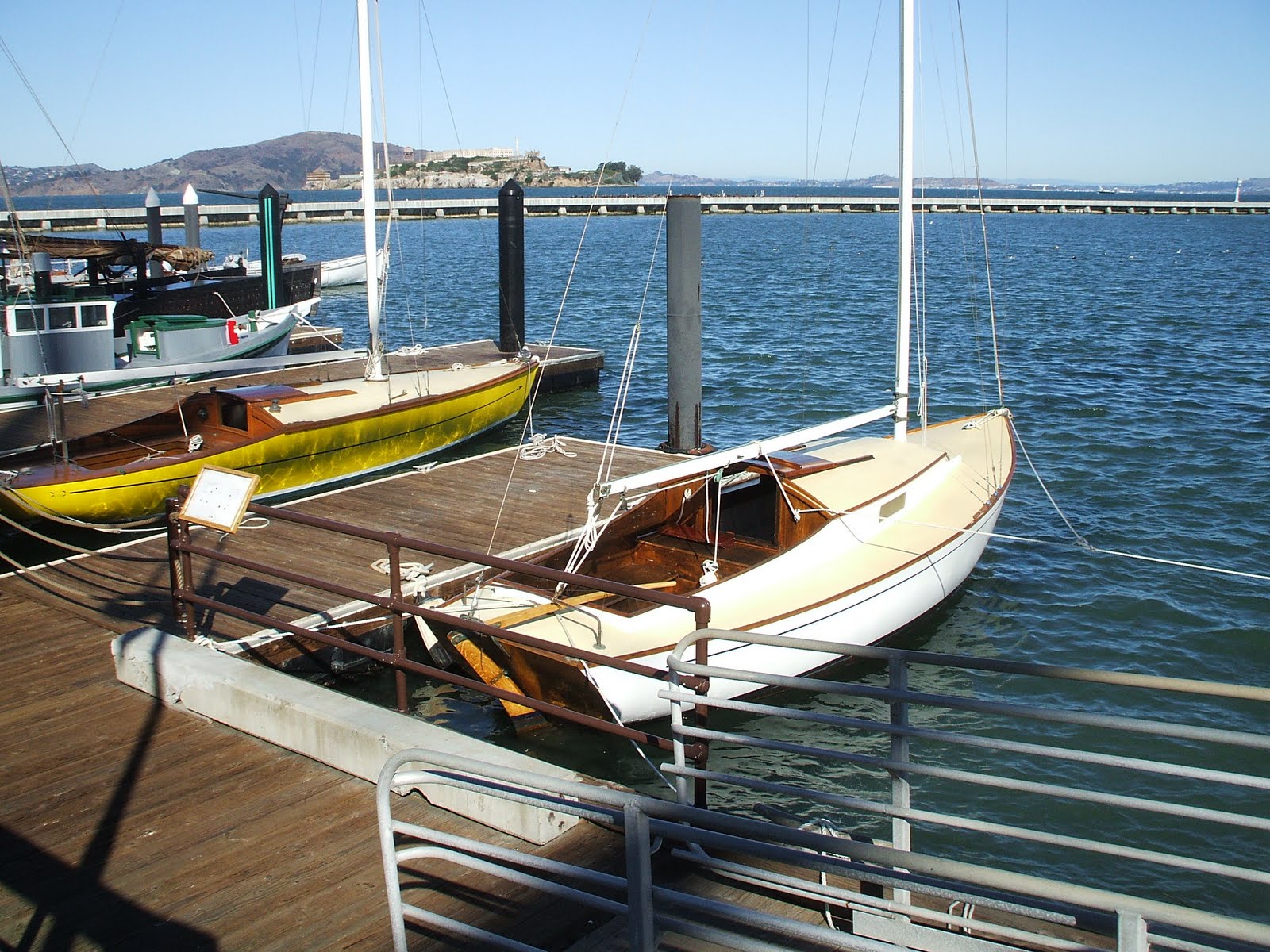


These are photos of some of the boats at the Maritime Park and its surroundings. I've included photos of some of the information plaques in the hope that they can be read when enlarged (by left click of the mouse).
The top two photos were taken at a superb maritime museum nearby. The second photo shows me hoisting the first gaff sail since when I sailed Chiquita so many years ago. I think that it is a model of the scow schooner Alma shown further down.
But information in this blog should not be all one-way, so what is shown in the top photo? Serious comments are welcome.
The third photo is of the ship Balclutha, described further down.
The fourth photo shows the US Park Police keeping us all safe.
The dark-hulled boat that appears to have rivets on its side is one of the original San Francisco Bay shrimp boats.
Further down is a photo of a resident sea lion. ... Obviously a male, with his big mouth incessantly telling the world how great he is.

The second-last photo is of a humbler male about to enter the maritime store.
The last photo is of the scene from the bench where we had lunch.
Subscribe to:
Posts (Atom)